Independent fan guide. Details reflect the launch patch (v1.0.3) and cite official sources; if the game updates, in-game text always wins.
01What the call actually is
The last thing you do in Worming from Home is sit a performance review. The promotion interview is a timed video call with Steve, graded like an arcade run, and the game's own pitch for it involves managing multiple tasks to keep up your pretence of humanity. Steve talks. You react. Several things need doing at once, the timer runs regardless, and at the end a letter grade lands. Only 11.4 percent of players have earned the S — roughly one in nine — which for a five-to-eight-hour game is a serious filter.
What makes the call hard is not any single task. Each beat alone is trivial: hold up a photo, type five digits, press a button, share a screen. The difficulty is the packaging. You are a ragdoll worm operating all of it with your face, the prompts arrive on Steve's schedule rather than yours, and at least one typed answer is on a clock. A launch streamer put it plainly when the limit appeared — 'Oh my god, a time limit' — and that surprise is exactly what preparation removes.
This guide covers the finale for perfectionists: every verified beat, the order players report, the tricks behind the top grades, and an honest list of what remains undocumented. The shopping and desk setup live in the video call prep guide. Read that one first, because everything here assumes the checklist is already done.
02Before you dial in
Two achievements mark the runway. Locked In, hidden, at 33.9 percent, confirms you own the webcam, the soundboard and the framed photo — the physical kit the call assumes you have. Worm of Wall Street, also hidden, at 30.7 percent, is the finish line: it pops when you pass and hear that you are now the company's newest associate financial analyst. The gap between those two numbers is the exam. Roughly a third of players own the equipment; roughly a third pass; one in nine of everyone gets the S.
Your prep converts directly into grade. The community guide's list — max upgrades, memorized soundboard buttons, a cleared path to the PC, and total indifference to webcam framing — is not flavor advice. Every item maps to a beat in the call, which is presumably how the guide's author scored what they scored. Skip the checklist and the rest of this article punishes you for it.
One more number before the plan: 18.3 percent of players hang up on Steve during the call, earning Ugh, Boooooooringgggg. It is the speedrun ending and the tantrum ending at once. This guide is written for the other ending, but it would be dishonest not to mention that the hang-up is on the table the entire call, one grabbed handset away.
03The beats, as they arrive
An honest disclaimer first: nobody has published the call's full script, and the order below is the order players report rather than a verified fixed sequence. Steve drives the agenda. Your job is to be early for each beat, and that is what the rest of this section teaches.
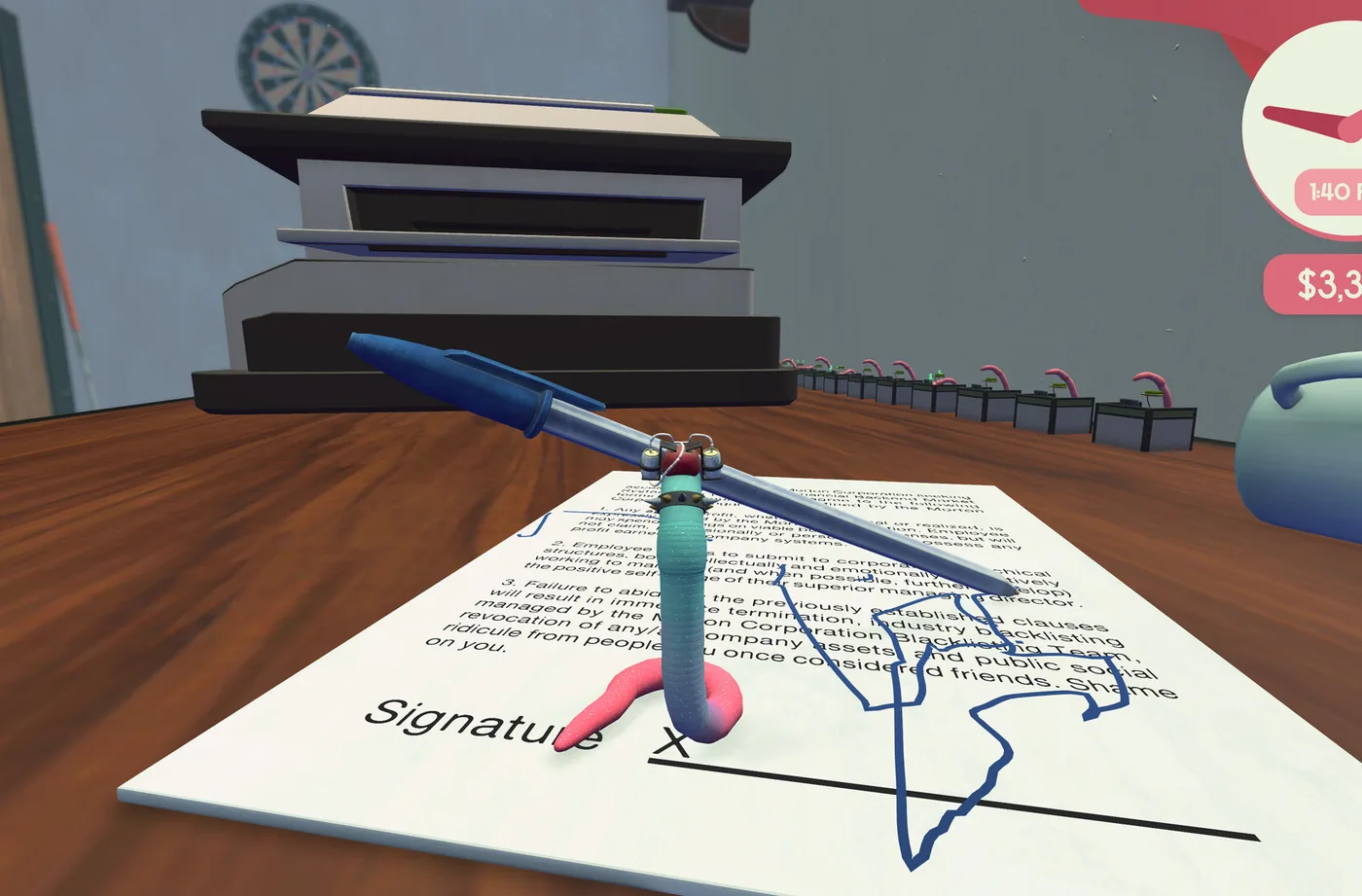
The documented beats, drawn from playthroughs and community threads: you show the framed photo to the camera, with a thumbs-up involved; you type your employee ID, 90764; you produce a timed typed answer; you hold an expensive purchase in front of the webcam for roughly a second while it scans; you screen-share your earnings report; you make soundboard noises; and at some point the computer restarts itself mid-call. That last one is not your failure. It happens in observed runs, to everyone, as scripted weather.
Between beats, Steve talks, and the store page warns you to keep up: quick thinking, several simultaneous tasks. The worm who looks best on this call is rarely the one with the fastest skull. It is the one whose desk is arranged so every prop, button and keyboard sits one short throw away, and whose attention is already on the next prompt while finishing the current one.
04The Kevin play
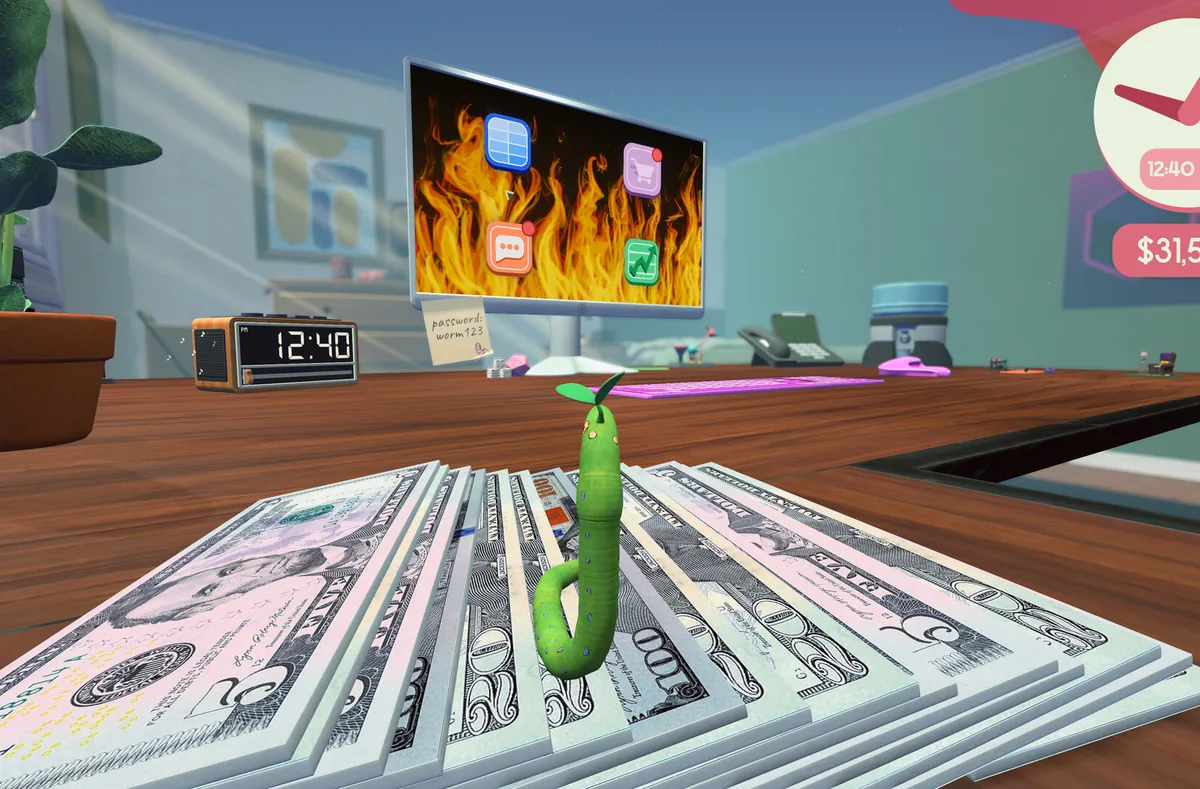
The single most famous trick in the finale costs 10,000 dollars. Kevin is the most expensive item in the shop, his store description says only that he does tricks, and he is required for nothing on the critical path. During the call, though, there comes a moment to show Steve an expensive purchase. Hold it in front of the webcam for about a second, a scan runs, and the status readout appears atop the webcam view.
In the Steam job-interview thread, one player reported that showing Kevin on camera was the difference in their S grade. That is a single player's story, not a verified scoring rule, and it deserves that honesty: the grader's internals are unrevealed. But the logic is at least plausible — the call wants proof you spend your salary like a winner, and Kevin is the most emphatic proof the shop sells. If you own him, this is his scene. If you do not, your priciest purchase carries the same beat.
Mechanically, the show beat is gentle. The scan takes about a second, the status appears atop the webcam view, and you do not need to hold the item steady like a passport photo. The mistake players make is choosing something far away or buried under papers. Stage your showpiece next to the camera before the call connects, and the whole beat becomes a one-second formality.
05Typing against the clock
The timed answer is where the S run lives or dies, because it is the one beat you cannot buy your way through. Typing in this game is one headbash per key, and the timer does not care that the E is across the keyboard. When a launch streamer hit the limit, their reaction — 'Oh my god, a time limit' — captured precisely the experience of discovering this unprepared.
The employee ID beat is the same skill at lower stakes: five digits, 9-0-7-6-4, and you can know them in advance because they are printed on the back of your monitor. Practice the sequence the night before, from your usual typing position. Five digits is long enough for a mistake and short enough to memorize, which makes it the most preventable lost point on the entire call.
For the longer timed answer, technique beats speed. Read the whole prompt once — the expected reply is shown, as with every message in the game, and it must be typed letter-perfect to send. Then type in chunks from a stable position, using short throws. If Backspace gets involved, let it; the wiggle of shame costs less time than a panic fling across the desk. A clean recovery is its own skill, even if nobody has confirmed the grader counts it.
07S grade or hang-up: the two poles
The Steam numbers draw the finale's two poles. At one end sits Absolute Expertise, the S grade, at 11.4 percent. At the other sits Ugh, Boooooooringgggg, the achievement for hanging up on your boss mid-call, at 18.3 percent. More players have quit the interview than aced it. The numbers sit close enough together that the community treats them as rival endings, and the game, to its credit, awards both with the same ceremony.
Between the poles sits the pass: any grade good enough to make you the newest associate financial analyst, worth Worm of Wall Street at 30.7 percent. The promotion does not come with a raise — the closing gag is that the title is the entire reward — so the S is not about money. It is about the letter. Perfectionists will understand, and everyone else can take the pass with a clean conscience.
One practical note for achievement hunters: both poles are achievements, and the hang-up is by far the easier one. If you want both, take the call seriously first. The S is the rare one, and hanging up on Steve remains available on every future attempt, however those attempts actually work — which brings us to what nobody has verified yet.
08The call, beat by beat
The plan below is written as the beats arrive rather than by the clock, because the clock belongs to Steve. Treat it as your cue sheet: when a prompt appears, the matching line is already rehearsed.
- Before connecting, finish the prep checklist: Locked In done, upgrades maxed, soundboard memorized, runway to the PC clear, photo and showpiece staged, ID in your head.
- Connect and settle. Get roughly in frame and stop adjusting — blocking the facecam is allowed.
- Photo beat: grab the framed photo, hold it up to the webcam, and give the camera a thumbs-up.
- ID beat: type 90764 in chunks, check it against memory, confirm.
- Timed answer beat: read the full prompt, type in chunks, and let Backspace happen calmly.
- Showpiece beat: hold Kevin, or your priciest purchase, in front of the webcam for about a second and watch the status appear atop the webcam view.
- Earnings beat: pull up your earnings report and screen-share it with Steve.
- Noise beat: hit the soundboard button you can find blind. Human noises only.
- Restart beat: when the PC restarts mid-call, take the cleared runway back to the keyboard without ceremony.
- When the grade lands, stay on the line. Hanging up is the other guide's ending.
09Does the S change anything?
Fair question, and the honest answer keeps perfectionists honest. The documented reward for the S is the achievement itself, Absolute Expertise, at 11.4 percent. The story ending is the same at every passing grade: Steve tells you that you are now our company's newest associate financial analyst, the credits energy arrives, and the raise does not. Nobody has documented an alternate scene, a bonus payment or a special item for the top grade. If an S-only reward exists, it is one more thing nobody has surfaced.
What the promotion unlocks, it unlocks at any passing grade: Imminent Layoff Mode, the harder second mode with deadlines on everything, and an endless post-game that players describe as idle gameplay, with the shop, the market and the daily loop still running and no further story beats. The S gets you there with better paperwork, not with different doors opening.
So the case for the S is the same as the case for a perfect spreadsheet: because it is there, because the call is the best-designed challenge in the game, and because a one-in-nine membership is small enough to feel like something. The case against is a hang-up, a laugh, and the same ending either way. Both are legitimate ways for a worm's career to conclude. Only one of them goes in the achievement cabinet at 11.4 percent.
10What nobody knows yet
The honest footnotes. Nobody has documented a failing grade on the call, and nobody has verified whether it can be retaken — the retry question comes up in every thread and no answer has surfaced. The only documented exit mid-call is the hang-up, which is a choice, not a score. Until someone tests it on the record, treat the call as unrepeatable and prep accordingly.
The grade scale above S is equally unrevealed. S is the top mark anyone has reported and the ceiling the achievement attaches to, but the game has never shown its full scale and the developers have not explained the scoring. Community-reported details — the soundboard's exact price, the grading weights, the fixed order of the beats — should all carry that same caveat. This finale is barely a week old at time of writing. Some of its secrets are presumably still unclaimed, which is a rare thing to be able to say about a guide.