Independent fan guide. Details reflect the launch patch (v1.0.3) and cite official sources; if the game updates, in-game text always wins.
01Where you start: about $41
A new save opens with roughly $41 in the bank, a clacky keyboard you will grow fond of, and a shop full of things you cannot afford. By the end of the story you are expected to produce $3,000 for a webcam, and the endgame shop keeps going from there: $8,000 for a coffee machine, $10,000 for Kevin. The distance between those two worms is the actual game, and every rung on that ladder is covered here with numbers we could verify and attribution where we couldn't.
There are three real income streams — spreadsheet work, stock trading, and interns — plus two bonus categories that reward having money rather than making it: bank-balance milestones with WormTok rewards, and one deeply stupid printer feature. Ranking them honestly means weighing startup cost, effort, and payoff ceiling separately, because the best hourly wage for a worm and the biggest top end are two different sources.
One contractual footnote before the numbers start. The contract on the way up the promotion chain signs your trading profits over to Morton Corporation, your employer, which is either a joke about modern work or the most realistic mechanic in the game. The balance you actually spend from is the bank account, and the game is not precious about it. Money in, money out, one progress report every night.
02Spreadsheets pay the bills
The salary comes first because it is the only income with zero startup cost and zero risk. Each spreadsheet file pays task-by-task, and the files are less intimidating than they look: each one needs a single input, a total, a value, or a choice from a list. Later files add Ctrl formatting requirements, which is where the die-parked-on-Ctrl trick earns its keep. Reviewers who finished the game independently describe the pay as surprisingly generous for what is literally one number per file, and they are right.
The volume bonus is the real engine. Complete five spreadsheet files within 24 hours and the game pays a $200 bonus on top of the task pay. That bonus restructures your day: instead of doing tasks as they arrive, you batch them, because five files inside the window is a raise and four is nothing. Players who treat the bonus as their base salary and the task pay as the tip report the early game feeling far less broke.
Then the job starts paying compound interest on itself. Spreadsheet pay scales with your Financial Insight level, and the advanced spreadsheets perk adds harder, better-paying files once you have it. All of that growth flows from the Reading Nook, which the community reports costs $10 — quite possibly the best return on investment in the entire game. Ten dollars in, a scaling salary out, plus the perk tree that eventually runs your whole portfolio.
03The stock market: highest ceiling, real risk
Trading arrives in stages. You start with a single tradeable stock on the work computer. The L-shaped desk at $1,000 plus its signed, printed, scanned and returned contract — the paperwork chain is its own achievement, Kafkaesque — opens the market to three stocks, and a later phone call grants what Steve calls full access to the stock portfolio. Each stage is a genuine pay raise if you use it, and the full guide to reading it is on the dip-buying page.
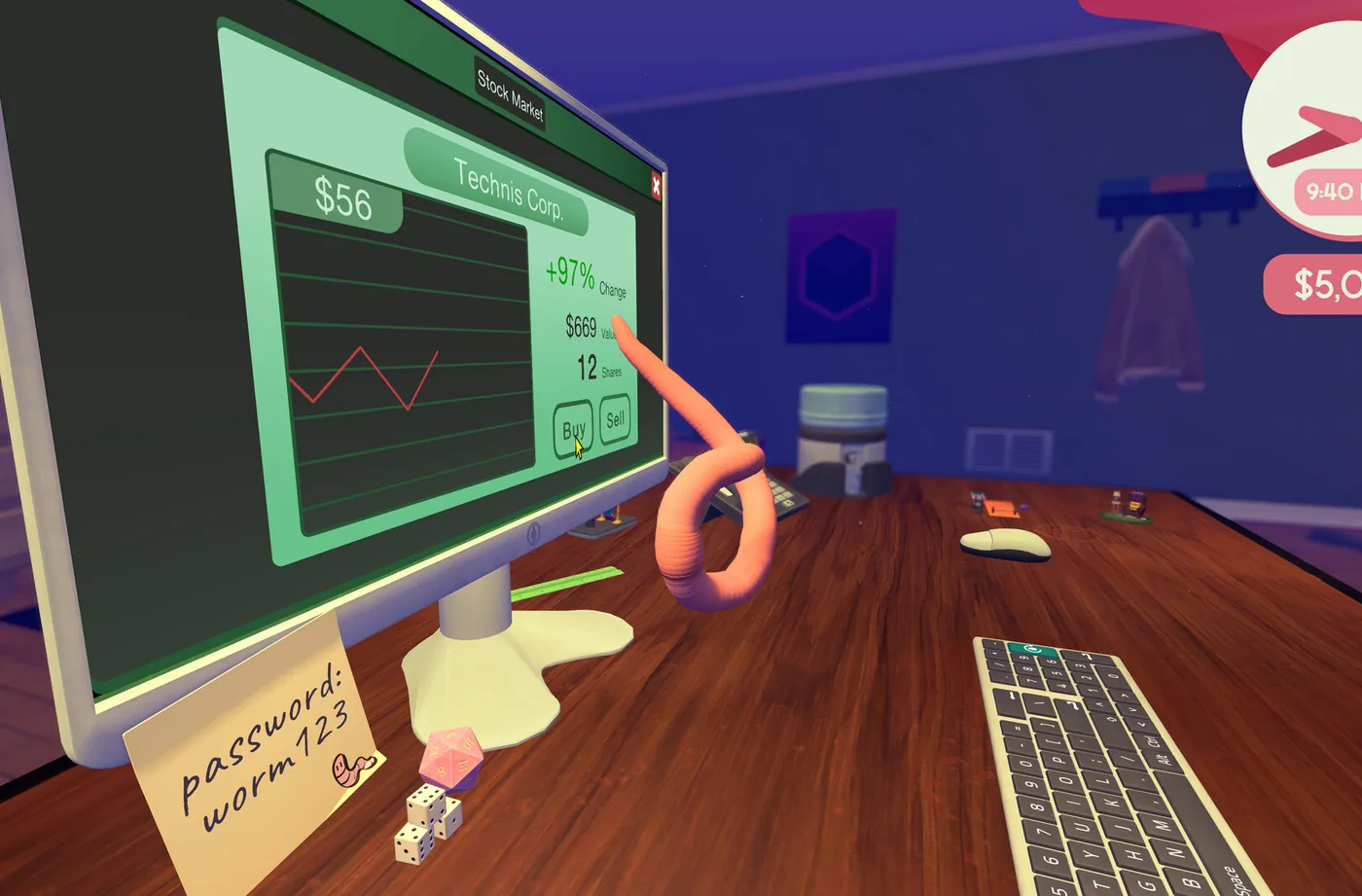
The numbers from launch week make the case. A verified portfolio screenshot shows a Technis Corp. position of 12 shares worth $669, up 97 percent on the day. A launch streamer who simply held shares overnight booked net-worth jumps of 17 percent and 21 percent across two nights. No spreadsheet bonus in the game touches that. The catch is that the market also goes down, tips move it more than skill does, and the tips arrive as Steve's voicemails and calendar events, so the real work is listening.
Three caveats keep it honest. Your own orders move prices — one player pushed a stock past $100 per share just by buying — so big orders slip against you as they fill. A Financial Insight perk pays 5 percent interest on idle cash, which quietly competes with mediocre trading. And the contract you signed on the way in gives the profits to Morton. You are trading for the net-worth line on the nightly progress report, and the net-worth line is having a great week.
04Interns: the passive-income engine
Interns are the closest thing this game has to a money printer with a pulse rate. The first one costs $400, verified on the official shop screenshot, and each additional hire raises the price by roughly $100. You can employ up to 100 of them, which is a payroll Steve never asks about. Once hired, they generate money in pulses — about $2 per pulse in observed playthroughs — without you touching anything. Buy ten and the Valuable Work Experience achievement pops, which 29.3 percent of players have, so the community is clearly sold.
The hidden mechanic is that interns can be permanently improved, and the developer has confirmed it. Douse an intern in coffee or water and their output is buffed for good, not for a timer. The Muscle Mass tree also contains an intern-upgrading perk, which means both perk trees feed the same passive engine. Set them up, splash them, and go do something else while the desk earns.
Honesty about the math: the $2 figure is an observation from played sessions, not a documented rate, and nobody has published a verified pulse interval, so we cannot compute a real payback period on a $400 hire. What we can say is that intern money arrives while you sleep, trade, and flirt with M, and that a fully doused late-game payroll of interns is the closest thing to post-promotion idle income the game offers. Interns can even be fired via spreadsheet, in the game's driest joke about middle management.
05Printing money: the jackpot that isn't
The printer — which the community reports costs around $1,250, and which needs the trampoline to even reach comfortably — can print money.pdf. A Financial Insight perk unlocks the cash-printing option, and the product is a $1,000 bill. Before you start planning your empire: the bill's quality is random. Player reports on the same feature run from one attempt to two solid hours of reprinting. It is a slot machine that pays in paper.
Here is the catch, and it is a beautiful one. The printed bill is cosmetic. It cannot be spent, and currently it cannot even be disposed of — the developer has acknowledged this on the Steam discussions — so a successful print leaves a gorgeous $1,000 bill sitting on your desk forever, looking exactly as rich as you are not. The real payout is the achievement, Is This Even Legal?, which 20.5 percent of players own. As money-making goes, it ranks last by design: the joke is the point, and the joke is that counterfeiting is worthless.
One crossover detail for completionists: printed money does not count as a pushable item for the Give Me Attention achievement — the developer confirmed papers, printed money and interns are all excluded. So the bill is not currency, not furniture that scores, and not trash. It is art. Print one, frame it with your eyes, and move on to income that spends.
06Milestones, WormTok and the first millionaire
Milestones do not make money; they reward you for having made it, and the difference matters when you plan your week. The Smartphone's WormTok app gives every achievement and challenge a claimable reward, and some of them track your bank balance directly. Hit $100 in the account and the RGB mouse is yours to claim. A reward tier waits at $100,000 as well, which turns an arbitrary number into a shopping deadline.
The $100,000 mark also carries the funniest achievement name in the game: 10% of the Way to Buying a House, awarded for having $100k in the bank, currently owned by 10.7 percent of players. The name does the math on the housing market so the worm doesn't have to. Claiming WormTok rewards along the way — hats, the rainbow skin, cursors, desktop backgrounds, keyboard skins — feeds Worm-fluencer at 7.8 percent, the rarest achievement most players will realistically chase.
For proof the ceiling is high: the first player publicly reported to hit $1,000,000 received a personal congratulations from the developer. That is the honest summary of this game's economy. A million is reachable, the developer is watching, and somewhere out there is a worm who got there on spreadsheets, tips and a hundred caffeinated interns.
07The ranking, with reasons
Ranked by effort-adjusted reliability — what a worm earns per unit of wiggling — rather than raw ceiling, because the two orders are different. Spreadsheets win on reliability: no startup cost, no risk, scaling pay, and a $200 bonus that rewards showing up. Interns win on passivity: they earn while you do anything else. Stocks win on ceiling and nothing else, and the ceiling is spectacular. Milestones and the printer are listed for completeness, and one of them is a joke.
If your goal is the $100,000 achievement, the practical ladder is spreadsheets into Financial Insight, Financial Insight into trading perks, trading profits into interns, and interns into the background hum that gets you over the line while you sleep. Every verified number behind that ladder is in the table below.
| Income source | Startup cost | Effort | Payoff | Notes |
|---|---|---|---|---|
| Spreadsheets | $0 | Medium, active | Steady task pay plus $200 per five files in 24h, scales with Financial Insight | The salary. Available from day one and forever |
| Interns | $400 first, about +$100 per hire, max 100 | Low after setup | Passive pulses, about $2 observed per pulse | Coffee or water dousing buffs them permanently, dev-confirmed |
| Stock trading | $1,000 for the L-Desk, plus capital | Medium, research and timing | Highest ceiling; 97% day and +17%/+21% overnight nights observed in a launch stream | Tips arrive as voicemails and calendar events; your own orders move prices |
| Bank milestones and WormTok | $0 | Trivial | One-time items and achievements, not cash | $100 tier claims the RGB mouse; a reward tier waits at $100,000 |
| Printing money | About $1,250 printer, community-reported | Pure RNG, one try to two hours reported | $0 — cosmetic only | The $1,000 bill cannot be spent or disposed of yet; dev acknowledged |
08What the money is actually for
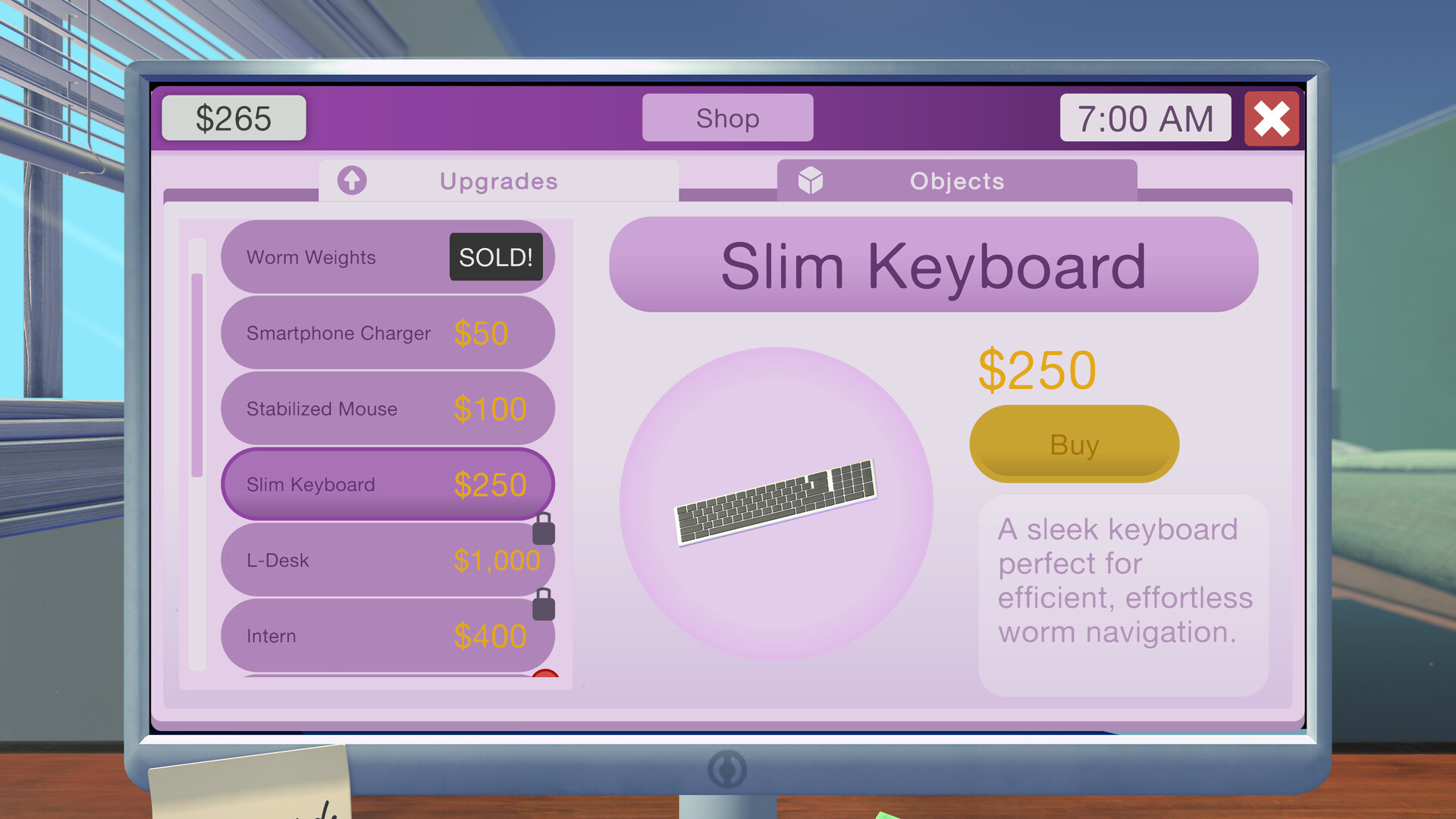
Earning means nothing if the spending order is wrong, so here is the price list that matters. The official shop screenshot verifies the cheap tier — Smartphone Charger $50, Stabilized Mouse $100, Slim Keyboard $250, Intern $400, L-shaped Desk $1,000 — and the playthrough-derived prices cover the rest: a pile of dirt to live in at $2,000 (delivered after three days), the $3,000 webcam, the coffee machine at $8,000, and Kevin at $10,000, the single priciest item in the store. Kevin does tricks. That is the feature list.
Two spending rules save runs. First, the L-shaped desk comes before everything fun, because it unlocks both the market and the promotion chain. Second, the webcam and soundboard are bought only when Steve's objectives ask for them — buying either early can soft-lock the objective chain, a known launch bug the developer is fixing. Every purchased item stays listed in the shop as SOLD, a tidy running record of how much this worm has spent on lifestyle.
The endgame of spending is Expensive Taste, the achievement for buying every item in the Shop, currently at 6.0 percent of players. Between that, Kevin, the coffee machine and the dirt, the total bill runs well past $30,000 — which is exactly why the income ladder needs more than one rung. Spend in this order: critical path, then income infrastructure, then Kevin, then joy.
09A first-week money plan
Sequence matters more than any single income source, so here is the order of operations that gets a new save from $41 to a trading portfolio without dead ends. Nothing here requires luck, and every number in it is verified elsewhere on this page.
- Day one: do every spreadsheet that arrives, and batch five files inside 24 hours for the $200 bonus.
- Buy the Reading Nook early — community-reported $10 — and put evenings after 9 p.m. into Financial Insight levels.
- Save $1,000 and buy the L-shaped desk; it unlocks trading and starts the promotion paperwork.
- Sign, print, scan and return the contract to move from one stock to three.
- Trade the voicemails, hold winners overnight, and keep a $3,000 webcam fund untouched throughout.
- Hire the first intern at $400 once cash flow survives it, and douse them in coffee immediately.
- Reinvest trading profits into interns until their passive pulses cover your daily spend.
- Luxury tier last: the printer and money.pdf if the RNG amuses you, Kevin when you are rich and silly.