Independent fan guide. Details reflect the launch patch (v1.0.3) and cite official sources; if the game updates, in-game text always wins.
01How prices actually move here
The market in Worming from Home is not a random number generator wearing a tie. It is an app on your work computer that unlocks in stages: you start with one tradeable stock, the L-shaped desk and its signed, scanned contract open the market up to three, and a later phone call grants full access to the stock portfolio. Steve announces the second step himself — you'll be able to trade three different stocks instead of just one — and Tippy celebrates it with the sincerity only a Clippy-shaped narrator can manage: three whole stocks, that's like the entire market.
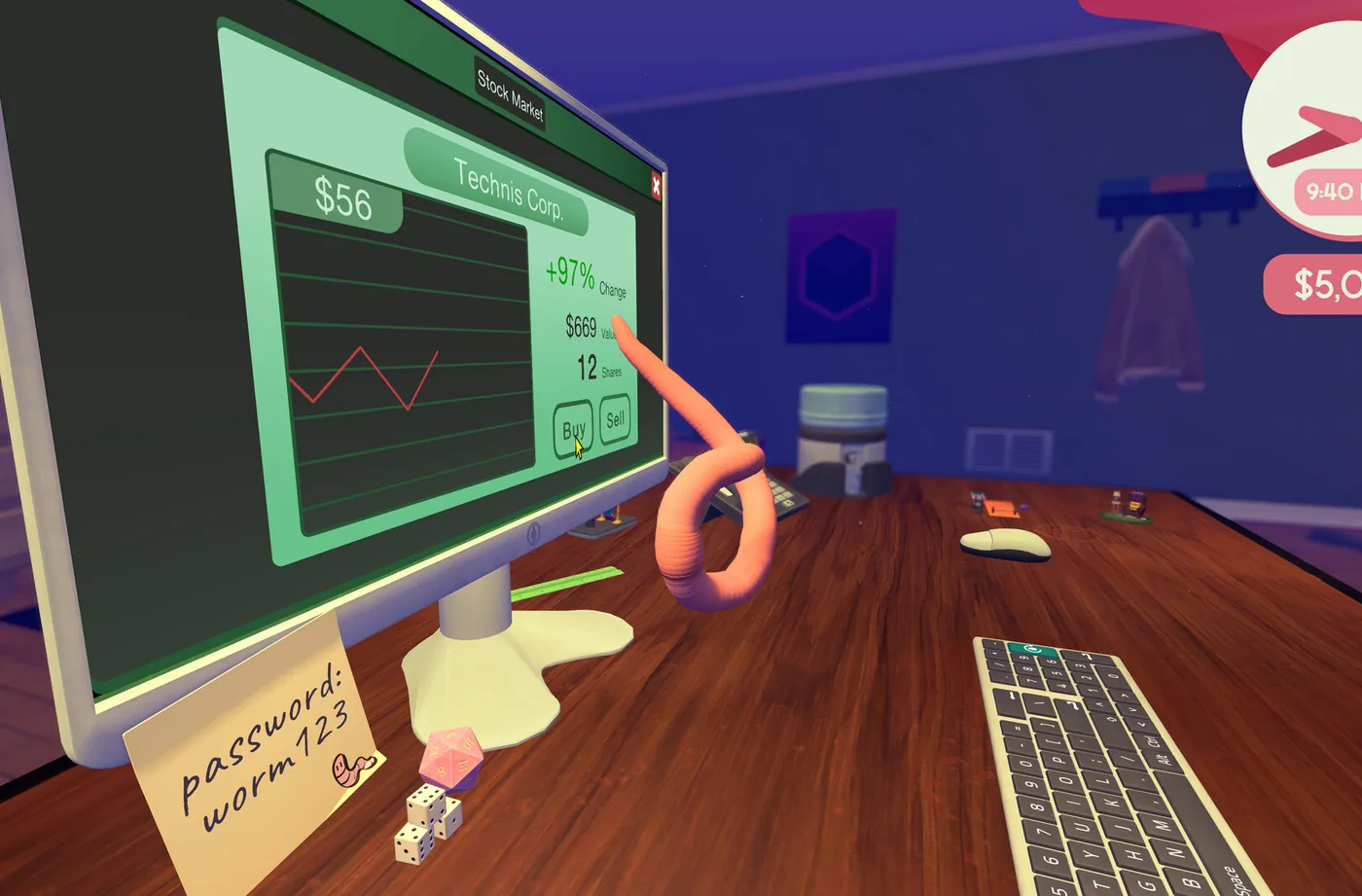
The terminal is almost aggressively simple. The verified launch-window interface shows a window titled Stock Market with one company at a time: Technis Corp., trading at $56, up 97 percent on the day, a 12-share position worth $669. Below it sit a line chart, a cash readout, and exactly two buttons, Buy and Sell. No shorts, no options, no stop losses. Everything clever you will do in this market has to be built out of those two buttons and the research you did before touching them.
Two footnotes matter before your first order. Your employer, Morton Corporation, owns all trading profits — it is in the contract you sign on the way to three stocks, and it is the game's best joke about employment. And you can lose money. No player report documents a debt mechanic, so the realistic floor is broke rather than bankrupt, but with roughly $41 of starting cash the difference is academic during week one. Trade small until the voicemails start paying for themselves.
02The chart doing atrocious
The canonical dip-buying moment of launch week belongs to AzureBay's playthrough. Mid-session she pulls up a chart that has clearly had a week, declares it "doing atrocious", and commits on the spot: we buy more. No hedging, no second opinion from a coworker, no macro thesis. The stock was hated, she had cash, and the phrase has become the community's shorthand for the entire strategy. It is also, for the record, a perfectly reasonable read of how this market behaves.
The same stream contains the cautionary half of the lesson. One of the game's companies — a phone maker whose name renders inconsistently in transcripts, something like "Tennis" — recalls 100,000 phones during launch week, and the chart responds the way recall charts do in the real world: down, with conviction. AzureBay had wanted to be positioned for that drop and wasn't, and she says so on stream. The regret is the instructive part. Dips in this game are not weather. They are news, and players who track the news eat players who track the wiggles.
That is the framework in three moves. Buy panic when you have a reason to believe the company survives it. Stay out of panic when the calendar says worse news is coming. And when a voicemail hands you the schedule in advance, being positioned before the drop is the entire edge — which is precisely the trade AzureBay watched sail past without her.
03Tips are signals
Tips reach you through two channels, and both are knowable in advance — which is the entire difference between this market and a real one. Steve's voicemails carry the actual calls. The wall calendar color-codes your obligations, blue for deadline tasks and orange for events, and market entries arrive with dates attached, the same way "Invest in the Stock Market — due 7:00 PM Day 4" does. A dated event is a trade with a schedule. This is a game where the inside information is delivered by a man who mostly wants to be complimented.
The signals split cleanly into bullish and bearish. On the bullish side, the launch-week example is a defense contractor whose name got garbled in every transcript but whose news did not: a fresh defense contract, exactly the kind of headline that lifts a stock and keeps lifting it. Biolatica spent the week in the news for the best possible reason — "they have a cure." The bearish side is more crowded. The phone recall of 100,000 units is the flagship, with layoff news and weak earnings arriving on the same channel. Treat every voicemail as a direction, not decoration.
Pre-positioning is the mechanical skill that turns signals into money. Because tips land as voicemails and calendar entries before the news visibly moves the chart, you can buy the defense contractor before the contract announcement, or clear out of the phone maker before the recall does its work. A Financial Insight perk goes one step further and pins news events directly onto the charts, which compresses the entire research step into a glance. Reading Nook hours are investing hours. The tree pays rent.
| Signal | Direction | Where it arrives | The play |
|---|---|---|---|
| Defense contract won | Bullish | Voicemail or calendar event | Buy before the announcement, hold the trend |
| Cure breakthrough (Biolatica) | Bullish | News event, shown on charts with the perk | Buy early and let the news work |
| Phone recall, 100k units | Bearish | News event, previewed by tips | Sell first; buy the dip only after it lands |
| Layoff news | Bearish | Voicemail or news event | Reduce or sit the cycle out |
| Weak earnings | Bearish | News event | Sell into strength before the date |
04Hold overnight, sleep well
The strongest argument for patience came out of the launch streams, and it is a big number. Holding shares overnight produced net-worth jumps of 17 percent and 21 percent across two nights in AzureBay's run — the kind of returns that make daytime chart-watching look like a hobby. Every day ends with a progress report on earnings and net worth, so you get the verdict in writing each night you hold. Two nights like that change what "long term" means for a worm on a one-week contract.
The logistics matter more than they sound. Sleep duration sets your next-day buffs and debuffs — around five hours of sleep leaves you running at reduced efficiency — and skipping sleep ends in an automatic pass-out around 3 a.m. A late Financial Insight perk removes sleep debuffs entirely, but until you have it the routine is boring: place the buy, crawl into the plant pot, let the market work the night shift. A worm staring at a line chart at 2 a.m. is paying tomorrow's debuffs for nothing.
Cash does not have to sit idle while you wait. The Financial Insight tree includes a 5 percent interest perk, which would be a scandal in the real world and is merely generous here. Between 5 percent on idle cash and double-digit overnight moves on shares, the whole tree points one direction: Financial Insight first, trading second. Book Worm, the tree's completion achievement, sits at roughly a third of all players, and most of them will tell you the perks carried the portfolio.
05You move the market. Don't chase your tail.
Here is the mechanic nobody expects: your own orders move prices. One player documented it in the Steam discussions, pushing a stock past $100 per share with nothing but their own repeated buying. Each buy nudged the price up, the next buy filled higher, and by the end the chart told a heartwarming growth story that was largely one worm in one room. The thread is worth reading for the numbers and for the tone, which is pure delight at the discovery.
Three consequences are worth internalizing before your first big order. Size matters: a large buy into one stock will move the price against you as it fills, so split the order and expect the average to be worse than the first share. Momentum matters: if a chart only started rocketing after your third buy, part of that rally is you, and it will sag when you stop feeding it. Exits matter too, because the mechanic runs in reverse — a big position sold slowly into strength is you politely providing the strength you are selling into.
None of this is a reason to avoid big trades. It is a reason to know who moved the chart before deciding it confirmed your genius. The $100-per-share experiment was run on purpose, for fun, by a player who understood exactly what they were doing. Copy the understanding, not necessarily the position size.
06Keep a cash buffer. The webcam is coming.
The real investing trap in this game is not risk, it is illiquidity. The promotion chain eventually demands a $3,000 webcam, plus a soundboard, plus a framed photo, and that is the cheap end of the late shop. The coffee machine runs $8,000. Kevin — who does tricks, and who has been linked to at least one S-rank interview — is $10,000, the priciest item in the store. Go all-in on shares the week before Steve asks for the webcam and you will be selling something at the worst possible moment: exactly when you need the cash.
The honest minimum buffer is $3,000 once the L-shaped desk is behind you — and buy that desk first at $1,000, since it is the reason you have a market at all. Park the buffer in cash and let the 5 percent interest perk babysit it. One launch-week bug belongs in every conversation about big purchases: do not buy the webcam or soundboard before Steve's objective asks for them, because early purchases can soft-lock the objective chain while the developer works on a fix. The buffer is for when the game asks, not before.
Keep perspective on what the money is for. Morton owns your trading profits either way; the scoreboard that actually pays out is the shop and the net-worth line on the nightly progress report. A cash buffer converts good trading days into interviews passed, conveniences purchased and dirt communed with. An empty cash account converts them into a great chart and no webcam — and there is no margin desk in this game to bail you out, just a worm who timed an illiquid week badly.
07When selling is the right call
Selling is the underrated half of dip buying, and in this game it has a clean primary trigger: sell before a bearish event lands, not after. The calendar is the seller's tool as much as the buyer's. Holding the phone maker into a scheduled recall, layoff news or weak earnings is not conviction, it is volunteering. The trade ends when the reason for it ends, and in a market driven by scheduled news the end date is usually written on the wall — literally, in orange.
The second trigger is your own footprint. If your buying moved a stock, your selling will move it back, so trim into strength rather than dumping: sell pieces while the chart is still rising instead of one order that knocks it flat. This is also how you fund big purchases without feeling robbed. Selling a third of a doubled position to buy the webcam is a good trade. Selling all of it in a panic on webcam day is a story you tell at parties.
The third trigger is hygiene. Tips expire. A stock bought on a voicemail two in-game events ago has no remaining thesis, and cash earning 5 percent interest beats a position you cannot explain in one sentence. And there is no rush, because after the promotion the game settles into idle play and the market keeps ticking. You can always get back in. Fear of missing out is not a verified game mechanic.
08What is not verified
This is the honesty section, because confident nonsense about this market is already circulating. Price update cadence: no verified source documents how often the charts tick. We know a Financial Insight perk makes the market tick faster when you drink coffee, which confirms some kind of tick system exists, but the actual rate — per minute, per hour, per cup — is unverified. If a guide quotes you exact tick numbers, that guide is writing fiction.
Chart features: fan wikis claim the chart window has 1D/1W/1M time-range tabs. No verified source shows that, and it sits on the same pile of wiki inventions as the meme-stock tickers this game does not have. The verified chart is one line and two buttons. Price floors: whether a stock can actually reach zero, and how deep a crash bottoms out, is undocumented anywhere we trust. No player has reported a worthless position, and until someone does, assume crashes are deep rather than fatal — and notice that "assume" is doing real work in that sentence.
None of the unknowns change the framework. Buy news you understand, hold overnight, sell before the bad date, keep cash for the webcam. The fog only matters to players optimizing tick timing, and those players are already deep in the discussions threads, happy as clams.
09The pre-trade checklist
Run this before any order bigger than pocket change. It costs about a minute of game time and it catches nearly every way a dip buy goes wrong here: bad timing, no exit plan, a thesis you cannot state, or an empty webcam fund on interview week. If you cannot get through the list cleanly, the trade is not ready, and the market will still be there after the next voicemail.
- Check the wall calendar for orange events dated before your planned exit.
- Play new voicemails first, and flatter Steve before asking anything of the market.
- State the thesis in one line: which news moves this stock, and when does it land.
- Choose the horizon now — overnight hold, event flip, or long parking.
- Size the order so your own buying cannot push the price against you meaningfully.
- Set the sell trigger in advance: before the bearish event, or into strength on the way up.
- Confirm the webcam fund is still intact after the order fills.