Independent fan guide. Details reflect the launch patch (v1.0.3) and cite official sources; if the game updates, in-game text always wins.
01How a message task actually works
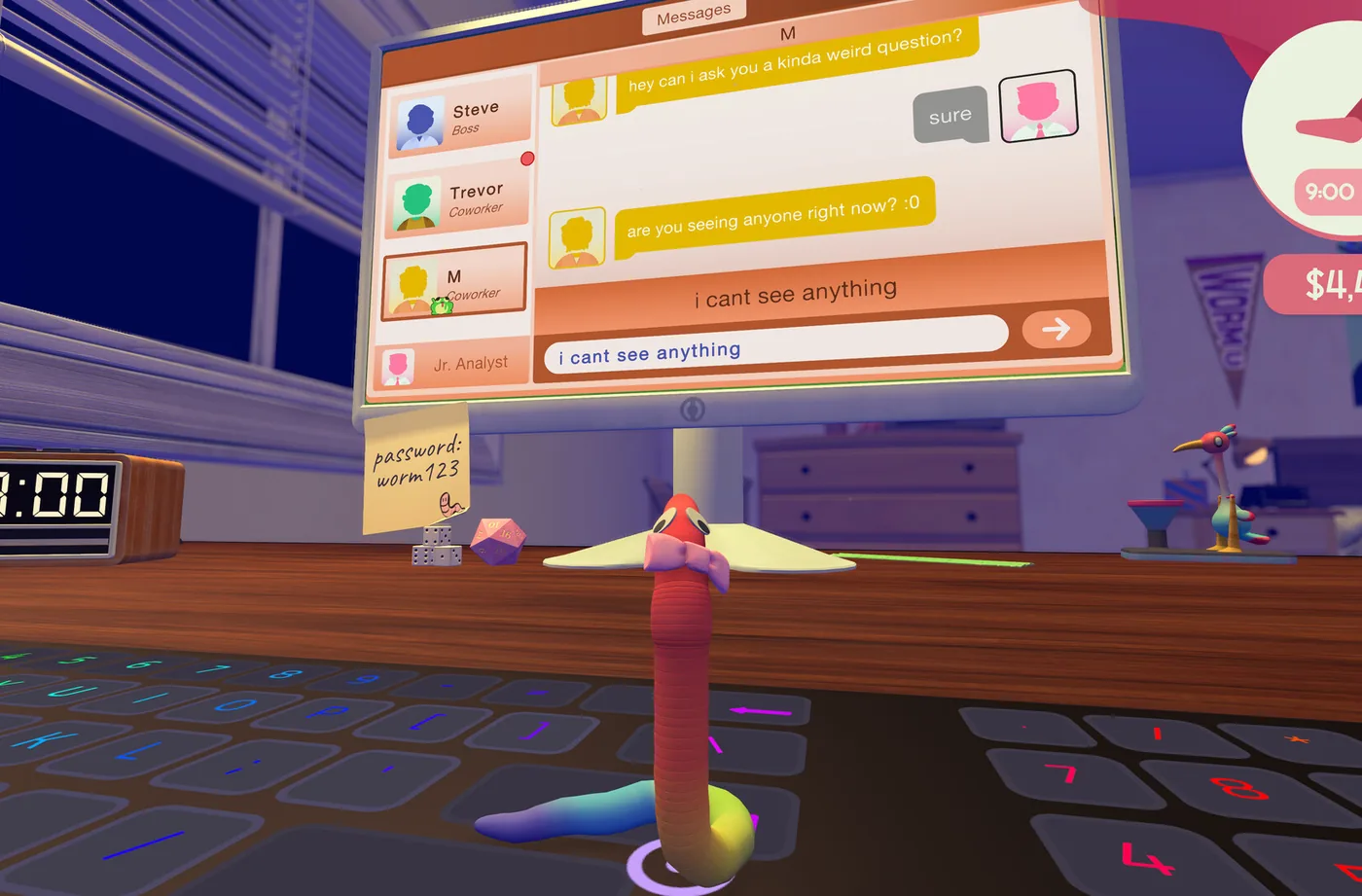
Messages arrive on the big monitor while you are in the middle of something else, the way real office messages always do. A coworker pings you, the window shows what they said, and a set of dialogue options appears underneath. Your first job is a choice: pick the option that matches the answer you want to give. That part looks like a normal game about normal people. Everything after it is pure Worming from Home, because picking the option does not send it. You have to type the thing yourself.
Once you choose, the expected reply appears on screen and you reproduce it on the keyboard, one headbash per letter. The bar for success is absolute: replies only send when they match exactly, letter for letter. A typo is not a personality moment. It is a redo. The game will not scold you and the coworker will never know you fumbled; the send simply does not happen until every character is right. Launch-week players assumed the system was broken the first time a reply refused to go out. It was not broken. Something in the string did not match.
So every message is two tasks stacked: a judgment call, then a transcription test. The judgment call is instant. The transcription costs you a crossing of the keyboard, a letter at a time, with a detour to Backspace for every slip, and the win condition is patience rather than speed. Slow and exact sends the message. Fast and wrong does nothing at all, as many worms have demonstrated mid-conversation with their boss.
- Notice the new message on the monitor and open the thread before starting any timed work.
- Read the coworker's message and every dialogue option before touching a key.
- Pick the option that suits the relationship you want with this person.
- Type the chosen reply exactly as shown, letter for letter.
- Correct typos with Backspace; the message will not send until it is perfect.
- Watch the reply leave, then get back to whatever deadline the message interrupted.
02The three contacts, and their rules
Three names message you, and each one runs on different rules. Steve is your boss, the administrator of your entire promotion, and a busy man. He wants one-word answers. Give him a paragraph and you are spending a busy man's time; give him the single word he asked for and the conversation proceeds the way he likes. His final interview runs on the same doctrine, so his chat thread doubles as free practice for the biggest typed moment in the game.
Trevor is the office sports guy, softball captain, bottomless chatter about games. His rule is the one players trip over: vague replies can offend him, and the game does not flag it. There is no warning, no meter, no Trevor is upset notification. You pick something that looks neutral, the thread moves on, and the offense is already on your file. Community threads describe players only finding out on a second playthrough, which is exactly the kind of quiet consequence a guide exists to warn you about in advance.
M is the third contact and the game's romance route, if you want it. Her thread has a guide of its own, so this one will keep to mechanics: her messages use the same pick-then-type system as everyone else, with one timing wrinkle nobody else has, and her questions are the only dialogue options in the game that change what your week contains. Flowers get ordered because of this window. Keep that in mind before you answer her carelessly.
Nobody else chats. Trevor and M live entirely in the messaging window, and Steve does his real business by phone while keeping a thread for the small stuff, so if a name is not one of those three, it is not a chat contact; it is the phone guide's problem. The phone rings, the monitor messages, and the division of labor never blurs.
03What each contact wants from you
Read the cheat sheet once now, and again the first time Trevor goes quiet on you. The middle column is the entire social game: match the shape of the reply to the person receiving it. One word for the man who wants one word, something specific for the man who takes vague replies personally, and a real answer for the woman whose questions are the story.
The right column is the mistake launch players reported most for each contact. Notice that two of the three mistakes cost nothing mechanical. They cost standing, which this game tracks silently and spends later, in conversations you did not realize were being scored.
| Contact | What they want in a reply | Common mistake |
|---|---|---|
| Steve | One word, because he is busy; the interview expects the same discipline | Typing him a full paragraph he never asked for |
| Trevor | Something specific; engage the sports talk or answer plainly | A vague, noncommittal option that quietly offends him |
| M | An actual answer; her questions are the romance beats | Fumbling the typing on her first message, the one with a clock on it |
04Typing the reply without despair
The typing layer is the same skill the whole game runs on, sharpened. You are headbashing keys one at a time on a keyboard built for hands, and a chat reply is the longest continuous string you type outside spreadsheet work. Technique carries over from the movement guide: throw short, wiggle the last stretch, and when a key fights you, come at it from the row below and bump upward. Aim beats power in this window more than anywhere else, because the target is a sentence, not a cell.
Backspace is the most important key in chat. Every slip means a trip to the top row, a press, and a trip back, and the community named the journey long ago: the wiggle of shame. Budget for it emotionally. A reply that takes three corrections is a normal reply, and on the rare occasion a timer exists at all, it is measured in real minutes, not keystrokes. Perfection is required. Speed, almost never.
One habit saves more time than any keyboard upgrade: read the full expected reply before the first headbash. The string stays visible while you work, and players who scan it first know where the capitals are, how long the sentence runs, and how much keyboard territory it covers before they set out. The worm who reads twice types once. The worm who types first visits Backspace three times and arrives cranky.
05Speed versus safety: the one real timer
Here is the good news that takes new players an hour to believe: chat is almost never timed. No message expires. No coworker storms off because you spent ninety seconds hunting the letter Q. You can leave a thread open, finish a spreadsheet, hit the gym, and come back to find the conversation sitting exactly where you left it. The only typed deadlines anywhere in the game are the finale interview's timed answers and a single exception in this very window.
That exception is M. An early message from her carries a real-time one-minute window, and answering inside it earns Wow, You're Desperate, currently held by 47.8% of all players. Sit with that number. The only achievements more common are the login achievement everyone gets by starting the game, the hundred yards of travel you rack up by simply existing, and the L-shaped desk the story shoves you toward. This is the most-earned achievement in the game you actually have to choose to earn, and the reason is simple: the setup is funny, and the bar is one minute.
One real minute is generous by this game's standards and brutal by a beginner's typing. If the reply is long, start the moment her message lands and do not stop to reread. If you miss the window, nothing bad happens; the romance keeps going and the achievement waits for a quicker run. And if the title stings a little, that is deliberate. The game knew exactly what it was naming.
06What you say echoes later
The dialogue options are not flavor. Two of the three contacts keep score, and the game stays quiet about both scoreboards. Trevor's grudge against vague replies is the clearest case: nothing announces it while it happens, and the consequence lives in how he treats you afterward. The system hands you a choice, the choice is real, and the only notification you will ever get is a guide like this one.
Steve's thread has an economy attached. He shares stock tips when he feels appreciated, and flattery in your replies is the cheapest lever that opens the vault. The tips are specific enough to trade the same morning, which makes a two-word compliment one of the best-paid sentences in the game. The investing guides cover what to do with the information; the chat habit that gets you the information starts right here.
Trevor connects to money from the other side. Later in the game you get the option to feed him bad stock tips, which quietly makes your conduct in this window part of a small ethical portfolio: keep him sweet, wound him with vagueness, or use him as a market instrument. What is documented is that the option exists and that his feelings are real; the exact long-term cost of each path is not pinned down anywhere we could verify, so this guide will not pretend otherwise.
And M's thread is the biggest echo of all. The answers you give her questions are romance flags, and seeing them through adds a florist call, a delivery window, a date, an achievement at 30.7%, a rainbow skin and a butterfly screensaver to your week. The relationship guide walks every beat. From the chat side, the summary is one sentence: her options are not cosmetic, and the first one is on a clock.
07Chat mistakes to skip
The mistakes here are small and extremely common. Answering before reading is the first: the option text is the reply text, and players who skip the preview are halfway through a sentence before they discover the capital in the middle. Choosing the vague option with Trevor is the second, usually because it looked like the polite neutral choice. There is no neutral with Trevor. There is engaged, and there is a strike against you.
The third mistake is treating the window like a deadline. It is not, with one famous exception, and players who sprint their replies just donate errors to the keyboard. The fourth is the opposite: ignoring messages for whole days because they felt optional. Nothing explodes, true, but Steve's threads carry objectives, and a message left unread can sit on top of time-sensitive information while you commune with the dirt.
The fifth is assuming the game is grading your personality. It grades your spelling, it reacts to your choices, and it keeps the rest to itself. The options are tools. Pick them for the outcome you want, not for the answer a better worm would give, because a better worm would have flagged the species issue on day one.
08An inbox routine that works
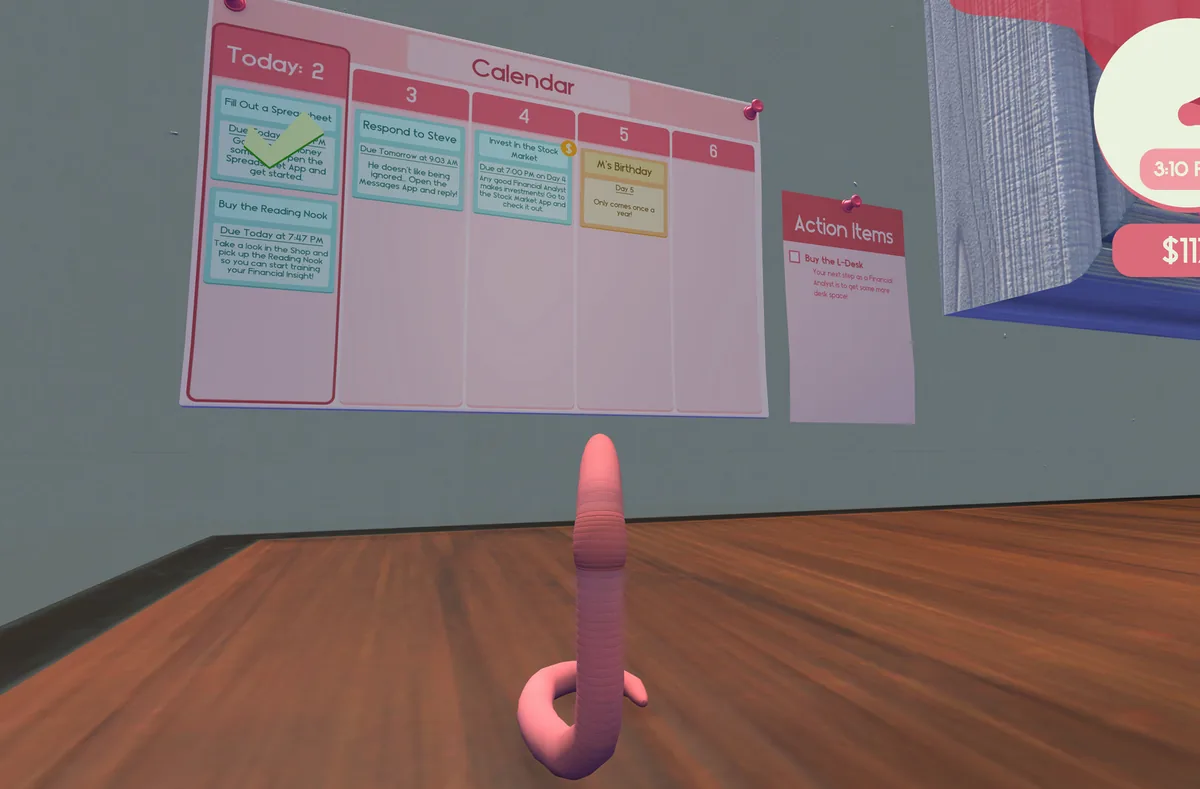
Chat fits the day best as a between-tasks activity with a few scheduled sweeps. The routine launch players settled into: clear messages right after the morning voicemail-and-calendar pass, sweep again at midday, and once more in the evening before the gym or the pot. Three checks cover everything, because message arrivals cluster around the workday and nothing decays when a reply goes out an hour late.
Order inside a sweep is simple. Steve first, because his threads carry objectives and the promotion chain. M second, because her early message has the one-minute achievement attached and her later beats have a delivery window downstream of them. Trevor last and unhurried, because his threads are the closest thing this game has to leisure reading, and speed-typing vague answers at him is precisely the behavior that offends him. If a sweep finds nothing, it cost you ten seconds.
Keep the phone in the same rhythm. Steve's real leverage runs through his calls, and the chat thread is where you keep him warm in between; both systems respond to the same flattery, and the community's working model is that a worm who compliments the boss in text gets better voicemails. Nobody has proven that formula, to be clear. It fits what playthroughs show about a man who shares tips when he feels appreciated, and it costs nothing to practice.
09Where chat sits in your week
Across a full week the messaging window costs maybe an hour of total typing, and it quietly decides your standing with every human who believes they work with you. Steve's thread feeds the promotion and the market. Trevor's thread is a friendship with a fuse attached and a walk-on role in the stock-tip mischief. M's thread is the heart of the game, on a clock at the start and patient afterward.
The branches from here: the relationship guide finishes M's story beat by beat, the phone guide covers the calls that carry Steve's real business, the controls guide drills the typing technique this window demands, and the spreadsheet guide handles the work the messages keep interrupting. Type slow, read twice, and answer M like the clock is running. Once, it will be.