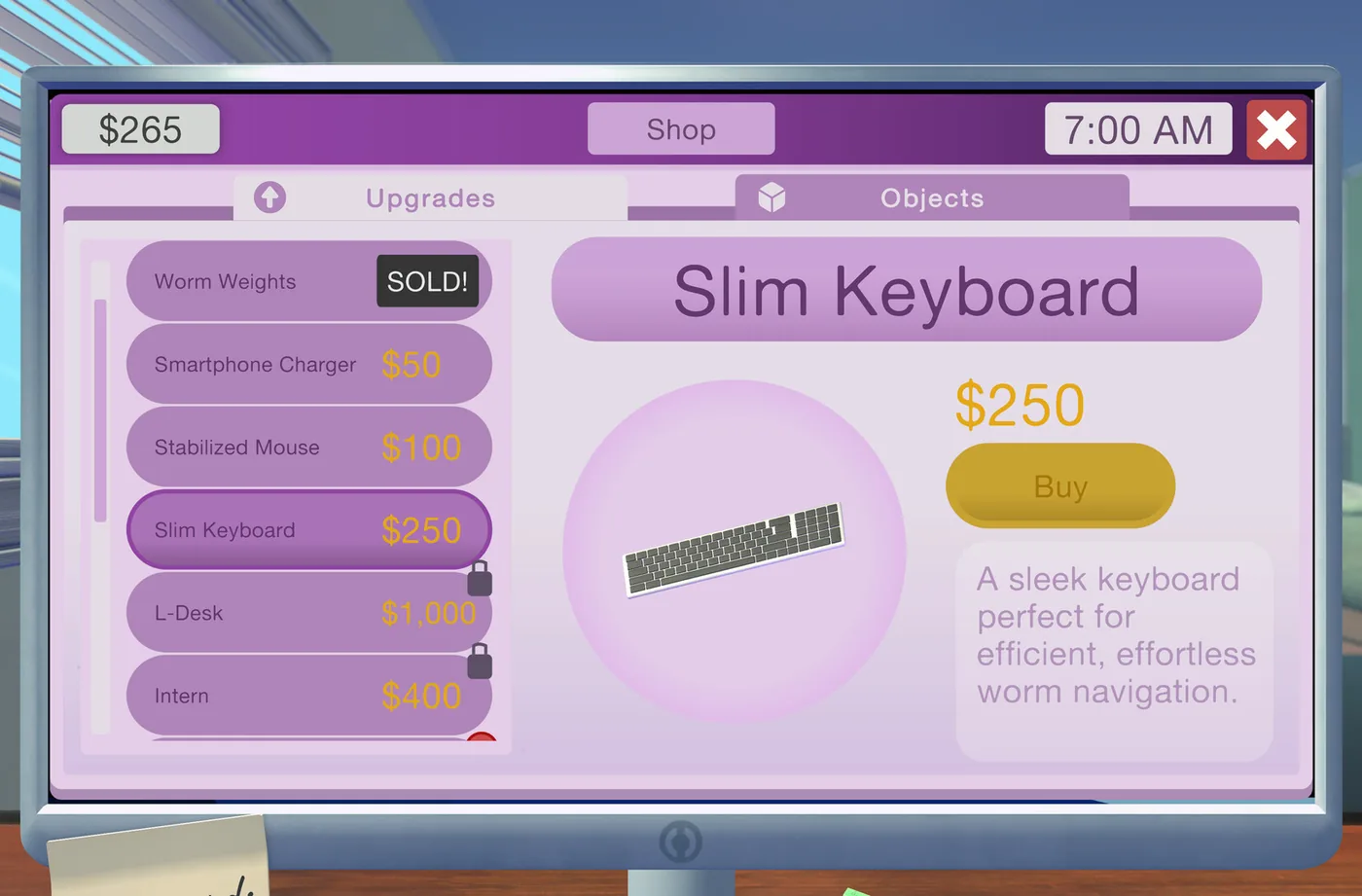
Independent fan guide. Details reflect the launch patch (v1.0.3) and cite official sources; if the game updates, in-game text always wins.
01Your first hire
Somewhere in the midgame, the shop offers you a Worm Intern for a verified 400 dollars, and the purchase is exactly what it sounds like: a smaller worm joins the desk and starts working. Not working in any way you have to manage. Interns generate ambient money in little pulses, they mill around the workspace, and they can be interacted with in ways that range from corporate to criminal. It is the closest thing this game has to idle income, and for a game built on physically typing every spreadsheet cell, that is a bigger deal than it looks.
The flavor is perfect, because the game commits to it. You are an invertebrate who has faked six years of employment, and your solution to workload is hiring creatures even less qualified than yourself. The interns do not have names, do not have contracts we get to read, and do not seem to be paid. What they have is a price tag, a pulse of income, and a boss who is a worm. Somewhere in that arrangement is the entire satire of the game's corporate layer, delivered without a single line of dialogue.
This page covers the whole system: how the price scales, the income math with honest labels on what is official and what is community-observed, the developer-confirmed coffee trick, and the full menu of things you can do to an intern, several of which are achievements. The short version: buy early, buy steadily, and decide before you hit double digits how much chaos your desk can absorb.
02How hiring scales: $400, then $500, then...
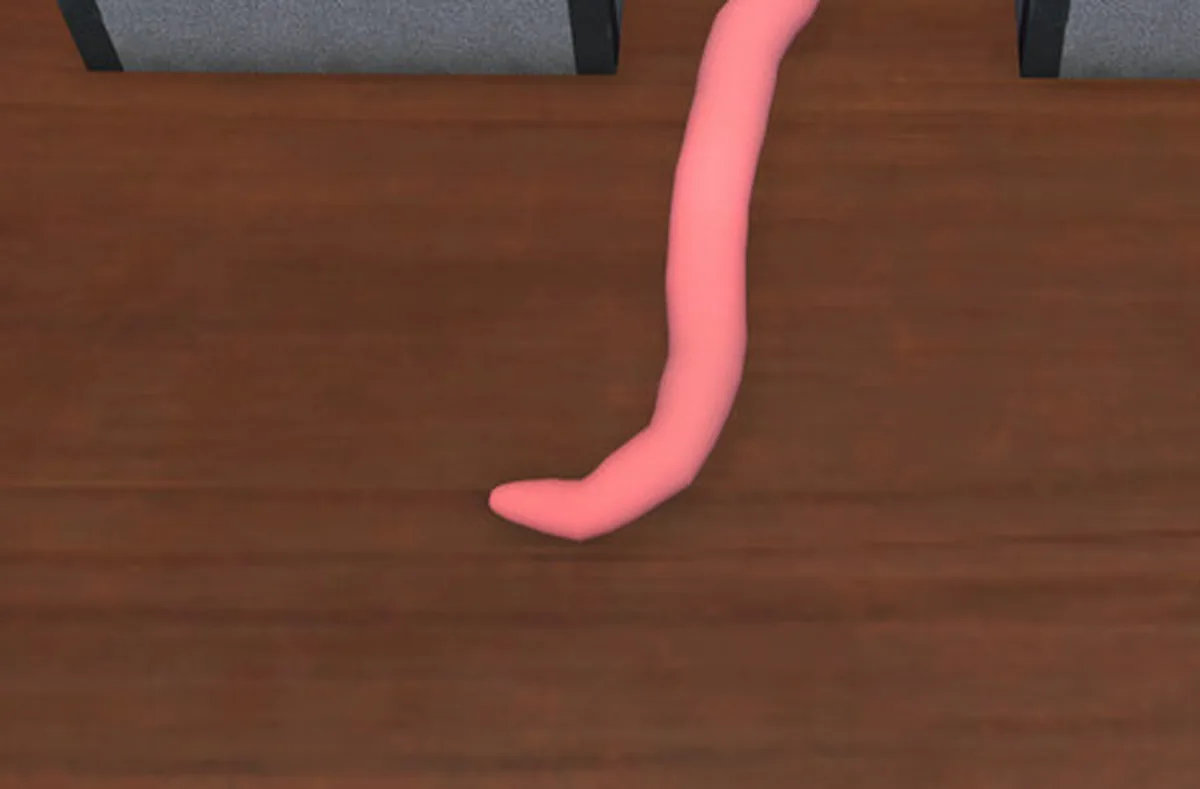
The first intern costs a verified 400 dollars. The second costs more: community reports put the increase at roughly 100 dollars per hire, so the fifth runs about 800 and the tenth about 1,300. Hiring caps at one hundred interns, which means the full program is a five-figure project if you ever take it to the ceiling. The shop does not warn you about the escalation, which is why it belongs in a guide: players who assume every intern is 400 dollars get a surprise around hire number six.
Arithmetic for the meaningful milestone is easy to hold in your head. Ten interns, the count tied to Valuable Work Experience at 29.3% of players, costs roughly 8,500 dollars in total: 400 plus 500 plus 600, all the way up to 1,300 for the tenth. That total is community math on a community-reported escalation, so treat it as a planning number rather than scripture. The shape is what matters: each hire costs more than the last, and the tenth costs more than three times the first.
Scaling the program is therefore a question of marginal value, not sticker price. Early interns are cheap income and cheap achievements. Late interns are expensive bodies for a desk that is already crowded, bought by players chasing completion rather than cash flow. The sweet spot for most playthroughs sits well below the ceiling, and the sections below give you the numbers to find yours.
03The money math, honestly labeled
What is official: interns generate ambient passive income in pulses, and they are the only idle-style money in the game. What is not official: the rate. One launch-week player observed roughly 2 dollars per pulse, the community adopted the figure, and the developer has not published rates anywhere we could find. Every payback number below is built on that single observation, so treat it as directional, not doctrinal.
On that observed rate, the first intern pays for a 400-dollar self in about 200 pulses, and the tenth, at roughly 1,300 dollars, needs about 650. Whether each intern pulses separately or the floor's rate is pooled is not established in any report we trust, and the pulse interval itself has not been publicly timed. The conservative reading, one flat 2 dollars regardless of headcount, would make intern ten a very slow investment; the optimistic reading makes the whole floor hum. Watch your own bank balance across a day with the progress report and you will know which game you are playing faster than any wiki could tell you.
So when do they pay for themselves? Honest answer: count pulses, not hours, because the interval is undocumented. What the community does agree on is the qualitative point that intern income arrives while you are doing something else: sleeping, reading at the nook, holding stock overnight. As background revenue funding the next real purchase, even a slow program pulls its weight. As a get-rich scheme, the market is simply better.
04Coffee and water: the dousing buffs
The one intern mechanic the developer has personally confirmed is also the strangest: dousing an intern in coffee or water buffs them, permanently. Not for a shift, not for a day. Permanently. The confirmation came from the developers themselves around launch, which puts it a tier above every income figure in the section above. If you are running an intern program, this is the mechanic to build around.
Water is free from day one. The cooler sits on the desk with its stack of cups, and a cup of water plus a nearby intern is a buff waiting to happen. Coffee is the deluxe version: it wants the coffee machine from the shop, a community-reported 8,000 dollars, which also happens to make the stock market tick faster with the right perk. One machine, two payoffs, and a considerable price tag. For a small program, water gets you most of the benefit at none of the cost.
The practical routine, distilled from player reports: douse every intern the moment you hire it, before it has generated a single pulse, so the permanent buff applies to its whole career. The physics of pour-and-hit are their own small skill, and spilled coffee on the keyboard helps nobody. Think of each hire as a two-step purchase: pay the shop price, then pay the coffee.
06Firing by spreadsheet
Yes, you can fire an intern, and yes, the mechanism is a spreadsheet task. The game does not offer a menu button or a handshake and a cardboard box; it opens a file, and the removal of an employee happens through the same interface you use for totals and cell values. Players have called it the most corporate mechanic in the game, and it is hard to argue: hiring was a purchase, but termination is data entry.
The mechanic exists, and the documented uses are what you would guess. Thin the herd when the desk gets unusable, undo a hire you made for an achievement, or simply exercise the power because the game let you. No report we could find documents any penalty, morale system, or consequence for firing, which is either a mercy or the bleakest joke in the file depending on how long you think about it.
Two practical notes before you open the file. Firing an intern removes its income along with its body, so do not terminate your floor the week you are saving for the interview kit. And the fired intern's slot does not reset the price ladder: with the community-reported escalation, your next hire after any termination still costs the going rate for your headcount plus one. The spreadsheet is permanent; the pricing remembers.
07Upgrading your workforce
Interns sit at a strange intersection of the game's systems: they are a shop purchase that becomes a gym project. The Muscle Mass perk tree, the one you feed with the Breakout-style gym minigame, includes intern upgrading among its tiers, which means your workforce can be physically developed like everything else in this worm's life. A doused intern was already an investment; a doused and upgraded intern is a small, loyal piece of infrastructure.
The pathway has gates worth knowing from the gym guide. Muscle Mass tiers are gated by equipment: Worm Weights first, then the Worm Barbell, then the Squat Machine at a community-reported 1,800 dollars. Training pays out best before 10 a.m., so the efficient routine is a morning gym session for perk points and a dousing round afterward. Intern upgrades sit in the same tree as your own movement and strength perks, so every point spent on the workforce is a point not spent on your jump height. Priorities are a lifestyle choice.
Is upgrading worth it? Nothing documented gives exact upgraded income rates, so apply the same honesty rule as the pulse figure: buff because the developer confirmed buffs exist, upgrade because the tree says it does, and measure the rest against your own progress reports. What players do agree on is that an upgraded, coffee-soaked intern floor feels like the closest this game gets to having staff, and the game is fully aware of how that reads.
08How many interns should you buy?
A worked recommendation, with the labels kept on. For the story run: ten, timed to Valuable Work Experience, hired as the budget allows and doused on arrival. That count earns the achievement, generates meaningful background income during the portfolio phase, and leaves the desk navigable. For the money run: keep hiring while the marginal hire still amuses you, because income figures past the first pulses are community-observed rather than official, and your own bank balance is the only trustworthy dashboard.
Completionists should know two things before chasing the ceiling. The developer has confirmed that interns do not count toward Give Me Attention, the push-everything-onto-the-floor achievement, so a hundred interns add nothing there but obstacles. Whether intern hires count toward Expensive Taste, the buy-everything achievement at 6.0%, is not documented anywhere we trust; if that achievement is your goal, assume the worst and keep the hiring budget fluid.
And a word about one hundred, because players do reach it. A hundred bodies on a worm-sized desk is its own kind of chaos: crossings take longer, physics collisions multiply, and the floor of your office becomes a slow-moving crowd that pays for itself. The players who run it describe it half as an income strategy and half as a bit. Both halves are correct, and by that point in the game you can afford both.
09Intern tips from the launch week
The system in five habits. Hire early and steadily rather than in one splurge, so the rising price ladder matches your rising income. Douse every hire immediately, coffee if the machine exists, water always. Bank the ten-intern achievement before experimenting with firings. Sequence the camera achievement inside interview week, after Steve's call makes the webcam legitimate. And leave firing until the desk is genuinely gridlocked, because the spreadsheet remembers your headcount even when the intern is gone.
Everything else about the program is temperament. Interns are the game's one passive system, and the temptation is to treat them as an optimization problem with a spreadsheet of their own. They are better as the office's ambient life: small colleagues, pulsing quietly, buffed past reason, occasionally thrown in a bin for a trophy. Somewhere between your first hire and your hundredth, the intern program stops being a purchase and becomes the personality of your save file. Hire accordingly.