Independent fan guide. Details reflect the launch patch (v1.0.3) and cite official sources; if the game updates, in-game text always wins.
01The thousand-dollar turning point
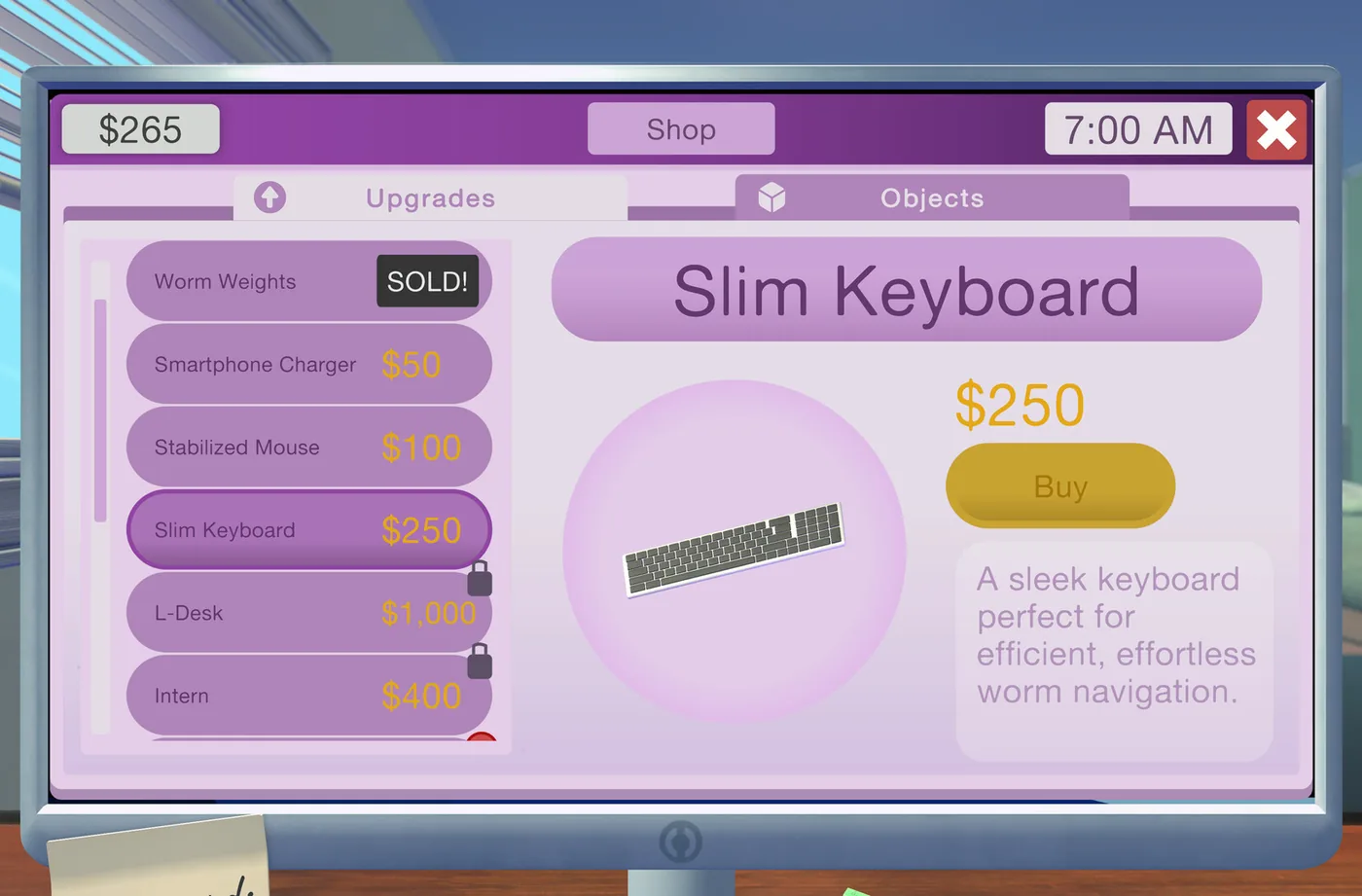
The L-shaped desk costs a verified 1,000 dollars, and it is the single most important purchase in Worming from Home. Nothing else on the critical path comes close. Buying it rearranges your workspace into an L, expands the stock market from one tradeable stock to three, and starts the contract chain that ends at the promotion interview. Every guide on this site eventually points back to this purchase, so here is the page that deals with it directly.
Achievement numbers tell you how central it is. Buying the desk earns Prime Real Estate, a hidden achievement sitting at 60.1% of all players. Remember that the log-in achievement is at 100%, meaning two in five players never bought the desk at all: they bounced off the game, or they are still living the one-stock life. Of the players who do buy it, most are committed to the story, because the desk is where the midgame begins.
What you are actually buying is furniture with consequences. The desk arrives, the workspace reorganizes around an L, and the phone starts ringing with the next step of the plan. It is the least glamorous thousand dollars in the shop and the one that changes the game. This page walks the whole arc: budgeting for it, what it unlocks, the paperwork it triggers, and the phase between the contract and the interview.
02Budgeting a thousand on task pay
You start the game with roughly 41 dollars in cash, so the desk is not a day-one purchase. It arrives for most players in the middle of the week, funded by the most boring revenue stream available: spreadsheets. Task pay is task-by-task, it scales with your Financial Insight level, and the game pays a 200-dollar bonus for completing five spreadsheet files within 24 hours. A disciplined Monday-through-Wednesday of tasks plus bonuses puts the desk within reach without any market risk at all.
Trading can accelerate the saving, and the one-stock era is built for it. The Financial Insight tree unlocks the stock app early, your single tradeable stock is a real chart with real moves, and the verified interface already shows the shape of the opportunity: one player's screenshot of the window shows a position worth 669 dollars across 12 shares, with the stock up 97% on the news cycle. Launch streams that held shares overnight logged net-worth jumps of 17% and 21% in a night. The market can absolutely fund your desk.
The honest budgeting advice is to combine the two rather than gambling. Grind the five-file bonus every day for the floor income, use the single stock for upside, and keep the webcam rule from the shop guide in mind: no interview equipment before Steve asks. A player who parks bonus money in the one stock and tops up with spreadsheets hits 1,000 dollars without a single desperate all-in trade. Slow capital is still capital.
03What changes on the desk
Physically, the upgrade is exactly what the name promises: your workspace rearranges into an L-shape, and everything you own gets repositioned around the new layout. The keyboard, the monitor, the phone, the dice and your accumulated clutter all find new homes. Players describe the first hour after the purchase as a small re-learning of the desk, because muscle memory built on the old layout now delivers you to empty space. The adjustment is short, and the new surface genuinely fits a working analyst's life better.
The practical consequence is more room with the same physics. A bigger footprint means longer crossings, which favors the short-throws-and-wiggles technique from the movement guide, but it also means the printer, the scanner and the second work surface stop competing for the same few inches. If your desk had become an obstacle course of trinkets, the L is a chance to place things deliberately. The Reset Objects option still returns toppled items when the new layout claims a victim.
Tippy marks the occasion in his usual spot, lower-right, once. His hints do not repeat, so if the desk's new mechanics confuse you later, the explanation already happened while you were admiring the real estate. That is the game's teaching style in miniature, and the desk is the last big system it introduces this quietly.
04Three stocks instead of one
The headline feature is market access. You start the game able to trade a single stock, and after the L-desk and the signed, scanned contract, Steve calls with the news in his own words: you'll be able to trade three different stocks instead of just one. Tippy celebrates the same moment from the corner of the screen, declaring three whole stocks, that's like the entire market. The joke is the point and so is the upgrade: the market triples, and the game's investing layer properly begins.
Three tickers change how you trade. With one stock you can only be right or wrong; with three you can be selective, and the phone starts feeding you distinguishable stories. Launch-week calls tipped a phone maker recalling a hundred thousand handsets, spelled something like Tennis in the interface, a clear stay-away; a company landing a defense contract, bullish; and Biolatica, in the news because they have a cure. Buy the good news, skip the bad, and hold overnight when the calendar backs the story.
The expansion does not stop at three. A later call grants what Steve describes as full access to the stock portfolio, and the trading guides on this site assume you have taken that call before getting serious about day-trading achievements. The desk is the gate for all of it: no L, no contract, no second ticker. It is the sturdiest progression gate in the game, and the reason the budget section above is worth the discipline.
05The contract chain: sign, print, scan, return
Almost immediately after the desk, the paperwork arrives. Morton Corporation wants a contract, and the game plays the full bureaucratic loop straight: you sign it, you print it, you scan it, and you return it. Completing that chain grants Kafkaesque, a hidden achievement at 36.0% of players. Set that against Prime Real Estate's 60.1% and you can read the drop: roughly three in five desk buyers finish the paperwork, and the rest stall somewhere between the signature and the scanner.
The chain is also where the game introduces its printing and scanning systems for real. The printer is a physical object with its own screen and its buttons on the top-left, reachable in practice by trampoline, and it ships with pens. The contract is not a menu click. It is a document you carry, a signature you physically complete, and a scan that can go wrong in a specifically office way. The next section covers the scanner so you do not become one of the players who lost an evening to it.
Take the paperwork seriously and it takes twenty minutes. The steps are short, the achievement is hidden until it pops, and the fine print on the contract is worth reading while the paper is in your, well, body. Because there is fine print, and it is about your money.
06Scanner basics so you don't scan a blank
The scanner is where the contract chain loses its casualties, so here is the workflow in one place. The golden rule is paper orientation: the sheet goes face-down on the glass. Face-up scans beautifully, and produces a flawless image of nothing. The green button on the printer opens the scanner lid, the buttons live on the top-left, and the whole machine is driven from its own screen rather than the PC. Finish every signature before you scan, because the scanner photographs what is there, not what you meant to add later.
Community printer guides exist because the failure modes are so consistent: the blank scan from face-up paper, the missing signature scanned into permanence, the lid that traps an overeager worm. When the scan is done and the contract is ready to go back, the bin behind the printer is the destruction point for documents you are meant to destroy, a different errand entirely. Reaching the printer at all is the trampoline's whole career.
One inherited warning from the beginner guide: never press Reset Objects while a print job is running, because the print button can vanish with the job half-done. That bug has stranded more paperwork than any scanner mistake. Print, wait, retrieve, then scan.
- Complete every signature on the contract first.
- Carry the paper to the printer without jumping.
- Press the green button to open the scanner lid.
- Place the sheet face-down on the glass.
- Scan from the printer's own screen, buttons on the top-left.
- Retrieve the contract and return it before anything else lands on the glass.
07The fine print: Morton owns your profits
Read the contract before you sign it, or at least read it after, because the game wrote it with a straight face. The fine print states that Morton Corporation owns all of your trading profits. Every dollar you make on the three stocks the desk unlocked technically belongs to your employer, according to the document you just wiggle-signed. The game does not stop you, warn you, or slow the text down for effect. It just puts it in writing and lets you keep playing.
Mechanically, nothing documented suggests the company ever collects. Your bank balance keeps climbing, the shop happily takes your money, and no player report we could find describes a clawback. Morton itself is not confirmed as a tradeable stock, so you cannot even buy the company that owns your gains. Read the clause as either the game's driest joke or a horror deferred to a sequel; the community has mostly settled on treating it as both.
It does add a flavor to the midgame that is worth noticing. You are an unlicensed invertebrate committing light securities fraud on insider tips, for an employer that contractually owns the proceeds, in pursuit of a promotion with no raise. The game never underlines any of this. The contract is the one moment the whole arrangement is put on paper, which makes it the funniest document in the game.
08What the L-desk unlocks, step by step
Here is the full arc in order, because the sequence matters more than any single reward. The desk is the first domino in a chain that runs to the end of the game, and each step gates the next. Use the table as a checklist: if you are stuck anywhere in the midgame, find your row and do the next thing.
| Step | What happens | Reward or gate |
|---|---|---|
| Buy the L-Shaped Desk, $1,000 | Workspace rearranges into an L | Prime Real Estate, hidden, 60.1% |
| Wait for the contract | Morton sends paperwork to the desk | Starts the Kafkaesque chain |
| Sign, print, scan, return | The full bureaucratic loop, done physically | Kafkaesque, hidden, 36.0% |
| Steve's market call | Trading expands to three stocks | The real investing game begins |
| Portfolio phase | Make some money, develop that portfolio | Funds the interview equipment |
| Full access call | Steve grants the complete stock portfolio | Endgame trading unlocked |
| Interview kit | Trampoline, webcam $3,000, soundboard, framed photo | Locked In, 33.9% |
| The video call | Graded interview with Steve | Worm of Wall Street, hidden, 30.7% |
09Between contract and interview
With the paperwork filed, the game enters a phase Steve summarizes himself: make some money, develop that portfolio. There is no deadline pressure documented for this stretch, and it is the game at its most open. Trade the three stocks, chase the five-file bonus, read at the nook and lift at the gym to fill out both perk trees, or start hiring interns to put income on autopilot. Players who rush this phase arrive at the interview under-leveled; players who enjoy it arrive rich.
Money is the real objective, because the next hard gate is a shopping list. When Steve's preparation call comes, it asks for the trampoline, the webcam at 3,000 dollars, the soundboard and a framed photo, and buying all three of the equipment pieces pops Locked In at 33.9%. That is several thousand dollars of spending, and the soft-lock rule still applies: the webcam and soundboard wait for the call, not before. The portfolio phase is long enough to fund it if you let it be.
The interview itself is its own page, and the preparation has genuine technique: max your upgrades first, memorize the soundboard buttons, clear a path to the PC, and remember your employee ID, 90764, printed on the back of the monitor. The desk got you here. What you do with the webcam is between you, Steve, and possibly Kevin.
10Desk buyers' quick answers
A few closing answers to the questions that come up in the discussions. Yes, the desk is worth buying before anything else expensive; every system worth having runs downstream of it. No, there is no documented way to preview the L layout before you pay, and no way back to the old desk; like the shop's keyboards, this is a one-way purchase. And yes, 1,000 dollars is exactly the verified price, not a rounded community estimate, so you can plan the savings target precisely.
If the midgame stalls after the purchase, check the phone before the forums. Steve's calls pace this entire chain, and a missed call is the most common reason a player with a nice new L-shaped desk and no objectives is confused. Answer Steve, file the contract face-down, and the rest of the week takes care of itself.