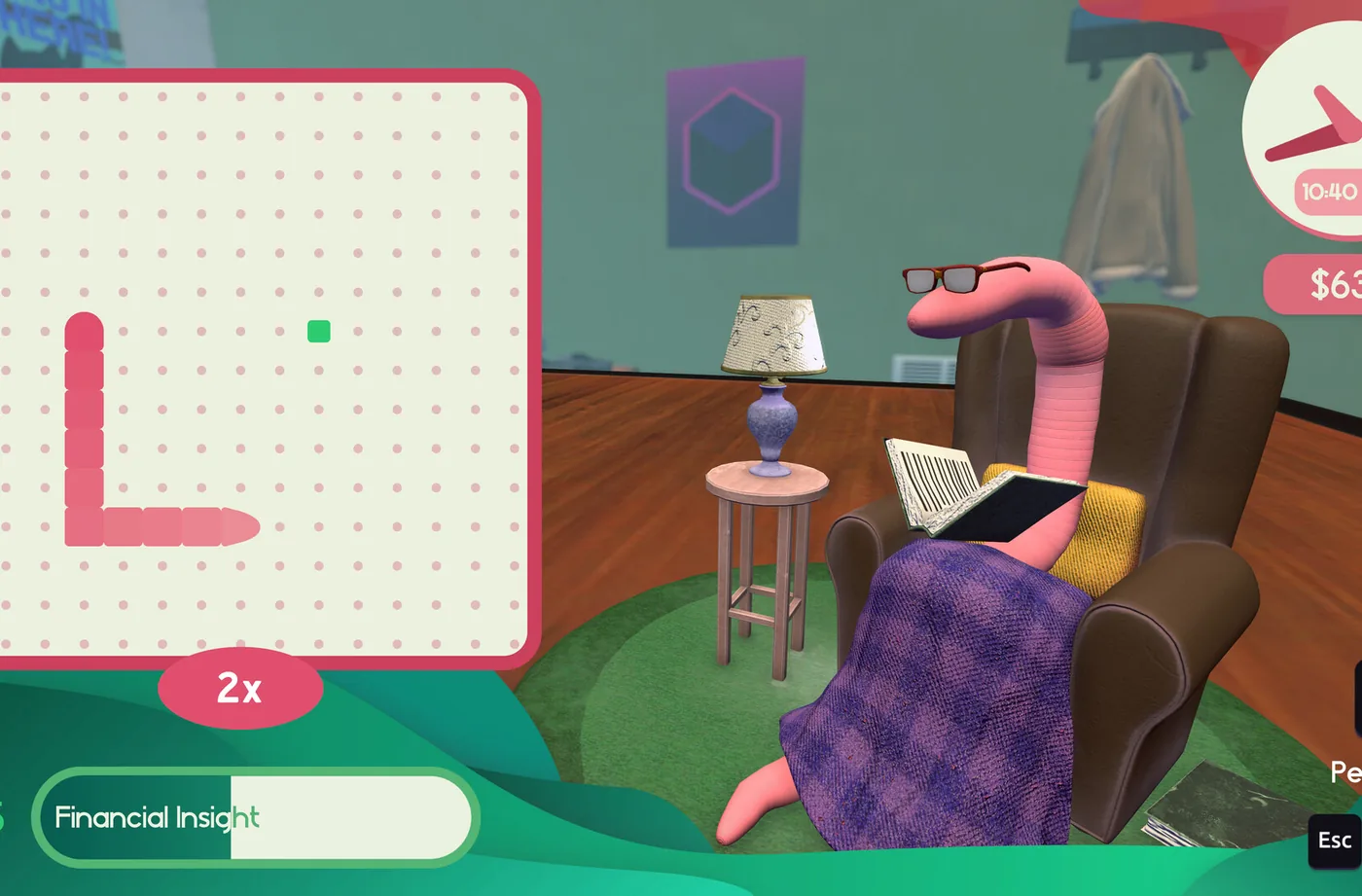
Independent fan guide. Details reflect the launch patch (v1.0.3) and cite official sources; if the game updates, in-game text always wins.
01Insider trading is the sales pitch
Most games hide their crimes. Worming from Home puts them on the storefront. The Steam page sells the fantasy plainly: use insider information to illegally game the stock market, and answer the phone occasionally. The second sentence is the joke and also, somehow, the tutorial. The illegal part is accurate, in the sense that your edge genuinely comes from non-public phone calls before the market hears them; the occasionally part is accurate too, because the entire compliance apparatus of Morton Corporation appears to be one man named Steve dialing you at inconvenient hours.
Context for anyone arriving fresh: you are a worm who has spent six years as a junior financial analyst at Morton Corporation without a single coworker noticing, working from a desk in someone's home. Insider trading is not a side hustle you discovered on your own. It is the business model of your week, taught to you by your boss, on company equipment, with company information, for company profit.
So when the phone rings at midnight and the word investigation comes up, it is genuinely startling, and it is built to be. This guide walks the whole set-piece so you know what is scripted theater, what has mechanical teeth, and, for the question everyone actually asks, whether anything in this game ever punishes the trading. Short version: relax. Long version below, with receipts.
02The crime the call is about
For the record any hypothetical prosecutor would read, here is the crime. Your edge is Steve, who drops stock tips over the phone and in voicemails, and shares more of them the more you flatter him. The documented tips have direction. A company that just landed a defense contract is bullish, a buy. A phone maker recalling a hundred thousand handsets, spelled something like Tennis in the interface, is bearish, a stay-away. Elsewhere on the wire, Biolatica has a cure, per the news, and the wall calendar tells you when to be positioned for market events. You are not guessing. You are being told.
None of which is subtle, and that is the joke the midnight call lands on. The trading app itself expands through the same channel: sign the contract after buying the L-shaped desk and Steve calls to unlock three tradeable stocks, with a later call granting the full portfolio. Every dollar of research advantage you possess arrived by telephone, unpublicized, from your own manager. When Steve asks whether you have received non-public knowledge, the perjury is almost structurally funny: the evidence is the phone he is calling you on.
03The midnight call, beat by beat
Midway through the story, past the L-shaped desk and the signed contract, the phone rings at midnight. It is Steve, and he is not calling about spreadsheets. The company is being investigated, he tells you, and then delivers the line the scene hangs on: I'm legally required to ask you some questions. This is on record. The exchange is played completely straight, mid-level-manager calm, while you listen on a handset roughly the size of your body. The beat comes from the launch playthrough, and it fires there as a story moment on the schedule, not a random audit that catches you mid-spreadsheet.
Nothing about the call appears timed, and nothing you did beforehand seems to trigger it early or buy it off. Think of it as a cutscene delivered through a phone: you pick up, Steve talks, you answer three questions, the game moves on. The reason to know all this in advance is purely emotional. The scene is engineered to make you believe you have finally been caught after a week of gleefully front-running your own employer. You have not been. Keep reading.
04The three questions
Steve's questionnaire is short and strangely formal for a conversation between a worm and its manager. As heard in the launch playthrough, it amounts to three items: have you received any non-public knowledge, have you kept any records, and do you know anyone engaged in insider trading. The comedy is that the honest answer to all three is yes, you, constantly, via this very phone. The practical answer is the one the streamer gave, which was no, three times, delivered without hesitation.
Then comes the flourish. Beyond the formal questions, the call lets you volunteer a name, and the documented playthrough blamed Trevor. Nothing happened. No flag, no follow-up call, no scene where he is escorted from the building; the game accepts the blame, files it somewhere off-screen, and moves on like a company that decided what its investigation would find before it made the call. Blaming him is optional, costless as far as anything shows, and very funny. Corporate ethics are a group activity.
- Question one: have you received non-public knowledge? Answer, on record: no.
- Question two: have you kept records? No.
- Question three: do you know anyone insider trading? No.
- Optional: offer a name. The documented answer was Trevor.
05The follow-up: destroy the expense report
The call ends and the game does something better than a penalty: it gives you homework. A task appears to destroy our expense report, with a bonus attached for handling it. Sit with that for a second. Morton Corporation's response to being investigated is to ask a junior analyst to dispose of a document, in the middle of the night, for extra pay. The satire is not subtle and is not trying to be. The bonus is real money by this game's standards, so treat the task like any other: get the paper, finish anything pending on it, and get it to the bin.
Logistics are pure Worming from Home. Documents are destroyed in the bin behind the printer, which sits where you need the trampoline to reach. Carry the report along the ground, never jump while holding paper, and if the shelf, the printer lid or gravity defeats you, Reset Objects puts everything back, with the standing warning not to press it while anything is printing. The whole errand is a two-minute physics joke with a payout at the end, which is this game's favorite kind of sentence.
06Where the call sits in the story
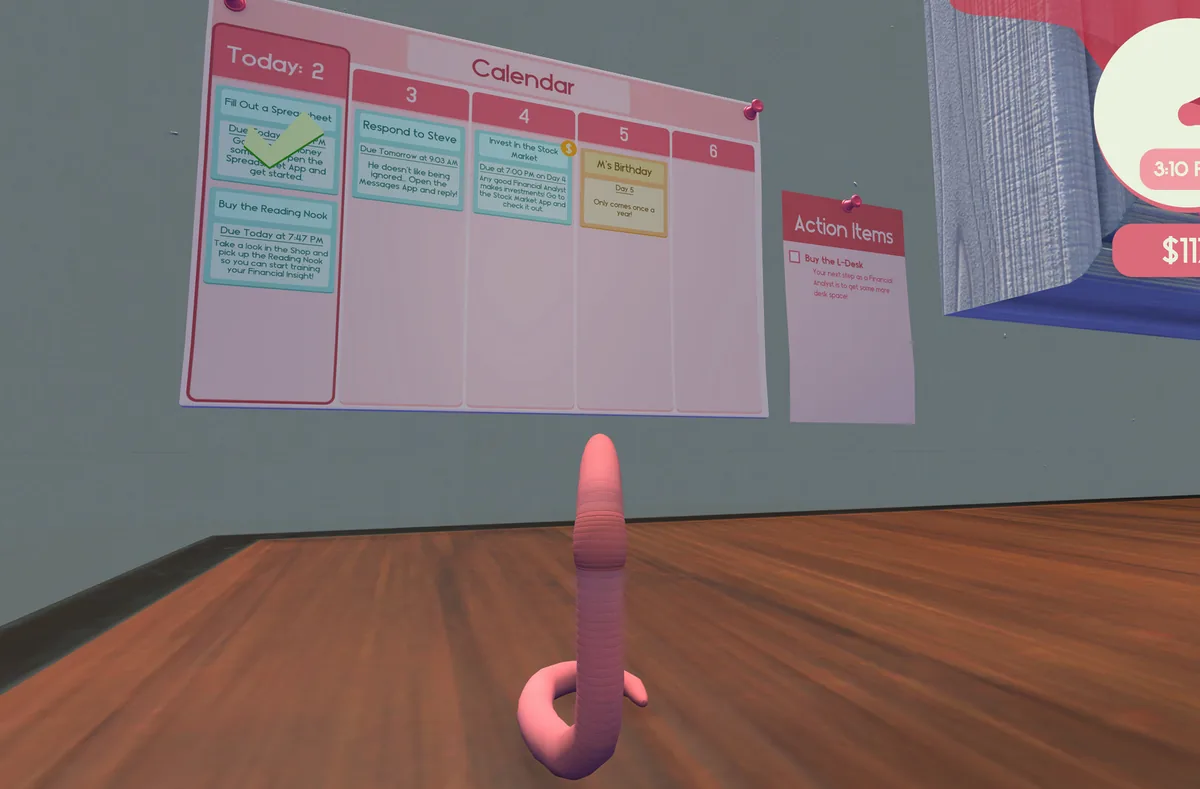
For orientation, the documented chain runs: buy the L-shaped desk, sign, print, scan and return the contract, make some money and develop the portfolio, and then, once Steve starts assigning purchases, buy the trampoline, the webcam, the soundboard and the framed photo for the graded video call. The midnight investigation lands in the middle stretch of that chain, past the contract, per the playthrough evidence. Nothing earlier in the week hints it is coming, which is rather the point of a midnight call.
Knowing the position helps twice. It tells you the call cannot show up before the contract is done, so early-week players can stop flinching at every ring, and it tells you what comes after, which is the most expensive shopping run in the game. One launch player showed a ten-thousand-dollar duck named Kevin to the interview webcam and earned an S grade, so the spending does not even have to be sensible. The investigation is a speed bump between two spending sprees.
- Buy the L-shaped desk and finish the contract paperwork (the hidden Kafkaesque achievement).
- Build the stake while Steve's calls expand the market from one stock to three, then the full portfolio.
- Take the midnight call: deny all three, blame Trevor if you like.
- Destroy the expense report in the bin behind the printer for the bonus.
- Work through the trampoline, webcam, soundboard and framed photo into the interview.
07What the penalty actually is
Here is the honest finding, stated plainly, because half the internet is currently inventing the opposite. No review, player guide, achievement list or footage we could verify contains an SEC, an arrest, a fine, a court scene, or any mechanic that punishes the trading itself. The investigation call is a scripted comedy set-piece with a paperwork errand attached. Reviewers have joked that the perpetrator is a worm, an animal with no skeleton to handcuff and no assets to freeze beyond a pot of dirt, and the game seems entirely aware of the loophole.
Be warned about the wiki farms on this exact point, because they love it. Fan sites have been publishing fabricated mechanics for this game since launch week, including a supposed Fired ending below 5,000 dollars and various numeric danger meters that supposedly trigger penalties. None of that is real; no verified source documents any way to be fired at all. The actual consequence of your crimes is written into the contract you signed: Morton Corporation owns all your trading profits. The crime pays. It just pays your employer.
08What a fine would even cost you
Part of the midnight panic is economic, so here is the actual money picture. You start with around 41 dollars in cash. Spreadsheets pay per task, five files inside 24 hours stack a 200 dollar bonus, and trading profits scale quickly once the tips flow, with overnight holds producing seventeen and twenty-one percent net-worth nights in a launch stream. Against that, the story's late invoices are steep: the webcam is 3,000 dollars, the soundboard is community-reported somewhere around 5,000, and a framed photo rounds out the interview list. A fine landing at the wrong moment would genuinely hurt.
Which is exactly why the scene is tuned the way it is. The investigation arrives late enough that you have started spending like a professional, and then, instead of taking money, it hands you a task that pays some. The promotion at the end of the line famously comes with no raise, and your contract already assigns every trading profit to Morton Corporation. The game has arranged things so the only party that ever loses money on your crimes is you, and only when you trade badly. That is not a justice system. That is a compensation plan.
09Trade as hard as you want
Since the law is not coming, the only real constraint is the market itself. You can lose money, no debt mechanic has been observed, and your own orders move prices, sometimes absurdly: one player documented pushing a stock past 100 dollars a share simply by buying. That is the actual risk model. Legal risk, zero, as far as anything documented shows. Market risk, very real, mostly self-inflicted, occasionally hilarious.
Practically, that means play the tips without guilt. Steve's voicemails and the calendar events exist to be front-run, and the entire Financial Insight tree is built to make you a more efficient criminal, from bulk-buying with Shift held to reading news events straight off the charts. The starter guide covers the mechanics of trading on tips, the dip-buying guide covers the bad days, and the day trader guide covers the 100-shares-in-a-day sprint. Commit the crimes. The store page already sold them to you.
10Midnight, handled
One distinction decides how you should feel at midnight: a scripted scene is not a system. A systemic penalty is a rule, trade on enough tips, get flagged, lose money, rank or access. A scripted scene is theater on rails: it fires once, at a story point, plays out the same for everyone, and leaves no machinery running behind it. Everything documented about the investigation points at the second kind. No heat counter exists, no player has reported a second investigation for continued trading, and the game's achievement list, otherwise thorough about recording your misbehavior down to filming interns without permission, never mentions the call at all.
Could a patch change that? In principle, yes: the game has already been through a day-one fix and the v1.0.3 achievement patch, and the developer is openly working launch bugs like the early-webcam soft-lock. If a future update puts teeth into the scene, the news post on the Steam page will say so. As of this guide's date, the midnight call is a bit, and a good one. Answer it, lie into the record, and go back to sleep; the voicemail has fresh tips by morning, and nobody is coming for the pot.
The compressed survival guide, one last time: let the phone wake you, agree that this is on record, say no three times, blame Trevor if the mood strikes, destroy the expense report by morning for the bonus, and be at your desk on time anyway. Six years of pretending to be an analyst should have taught a worm nothing if not composure. Then keep trading exactly as before, because the game's real position on insider trading was printed on the store page in the same font as the price. It is not a risk system. It is the job description.