Independent fan guide. Details reflect the launch patch (v1.0.3) and cite official sources; if the game updates, in-game text always wins.
01Insider information is a phone call
The Steam page sells this game with a confession: use insider information to illegally game the stock market, and answer the phone occasionally. Most players laugh at that and move on. You should not, because the two clauses are one mechanic. The insider information arrives through the phone, as voicemails from your boss Steve and as events written on the wall calendar, and the market on your monitor prices those calls in on a delay. Trade inside the gap between the voicemail and the chart and the game pays you, handsomely, for a crime it treats as a job description.
Set the scene, because the scene is the joke. You are a worm who has worked six years as a junior financial analyst at Morton Corporation, and your edge is embarrassingly corporate: non-public information about listed companies, delivered to company equipment, by your own manager, about stocks you are then encouraged to trade. Steve tips more the more you flatter him. The wall calendar dates the market-moving events in advance. Reviewers who finished the game describe the market as genuinely playable rather than a prop, and our reading of a full launch playthrough agrees: the tips have direction, the charts respond, and the money is real.
Two properties make the whole system work, and they are worth separating before any how-to. Tips have direction: a company landing a defense contract is a buy, a company recalling a hundred thousand phones is a stay-away, and Steve does not leave the interpretation to you. And tips are perishable: the edge exists only while the chart has not moved yet, which in practice means the morning the voicemail lands. Everything else in this guide is technique stacked on those two facts.
02The documented tips, and what each one says
The bullish flagship, heard in the launch playthrough, is a voicemail about a company that has just won a defense contract. Steve's delivery is exactly what you would expect from a man who believes he is being subtle, closing with an instruction players heard as get in there. The company's name is garbled in the stream captions, so we cannot print it with confidence, but the direction is unambiguous: buy it, before the chart figures out what you already know.
The bearish counterpart is a phone maker recalling one hundred thousand handsets. The interface spells the company something like Tennis, a name players audibly struggled with on stream, so treat the spelling as uncertain and the lesson as solid. A hundred-thousand-unit recall sinks a stock. No short selling appears anywhere in the verified interface, so the correct play is absence: do not buy it, do not average into it, and let less-informed worms learn the hard way.
The calendar supplies the slower material. Launch-week walls showed dated entries for layoffs and for weak quarterly earnings at a listed company, both of which read as bearish for the company involved, and the news cycle contributes Biolatica, a name that surfaces alongside the report that they have a cure. Not every entry moves a price, and not every move is large. But a dated calendar event is a scheduled surprise, and scheduled surprises are the easiest money in this game.
| Tip source | What it says | Direction | Your play |
|---|---|---|---|
| Steve voicemail (bullish) | A company just landed a defense contract; get in there | Buy | Buy the same morning, before the chart moves |
| Steve voicemail (bearish) | A phone maker is recalling 100,000 handsets (heard as Tennis) | Stay away | No position; the UI offers no way to short |
| Calendar event | Layoffs dated on the wall | Bearish | Be out of the affected company before the date |
| Calendar event | Weak quarterly earnings dated on the wall | Bearish | Sell into strength ahead of the report |
| News | Biolatica: they have a cure | Bullish | Position early and let the news land on you |
03Pre-positioning: the calendar leaks
Here is the mechanic that separates the rich worms from the salaried ones. The wall calendar shows market events with dates attached, in orange, before they happen. A quarterly earnings disappointment or a round of layoffs is therefore not news to you when it hits the ticker; it is an appointment you have had on the wall for days. Buying the run-up before a bullish event, or clearing out before a bearish one, is the most reliable trade documented in this game, and it requires no perk, no upgrade and no skill beyond your usual keybashing. It requires only that you read the wall.
The game introduces the whole system gently. Among the first blue deadline tasks is an entry reading invest in the stock market, due 7:00 PM on Day 4, which lands roughly an hour into a normal playthrough. You arrive at the app with about 41 dollars in cash and exactly one stock to trade, which is the game's way of saying this matters without letting you hurt yourself yet. Treat the deadline as the tutorial it is: open the app, read the screen, make one small trade, and start building the habit of checking the wall before the chart.
One perk closes the loop late in the tree. A Financial Insight upgrade paints news events directly onto the charts, so the information you used to assemble from voicemails and the calendar gets pinned to the line itself. It is the graduate version of the same habit: know what is scheduled, know which way it cuts, and be positioned before it happens.
04Reading the app before you trade in it
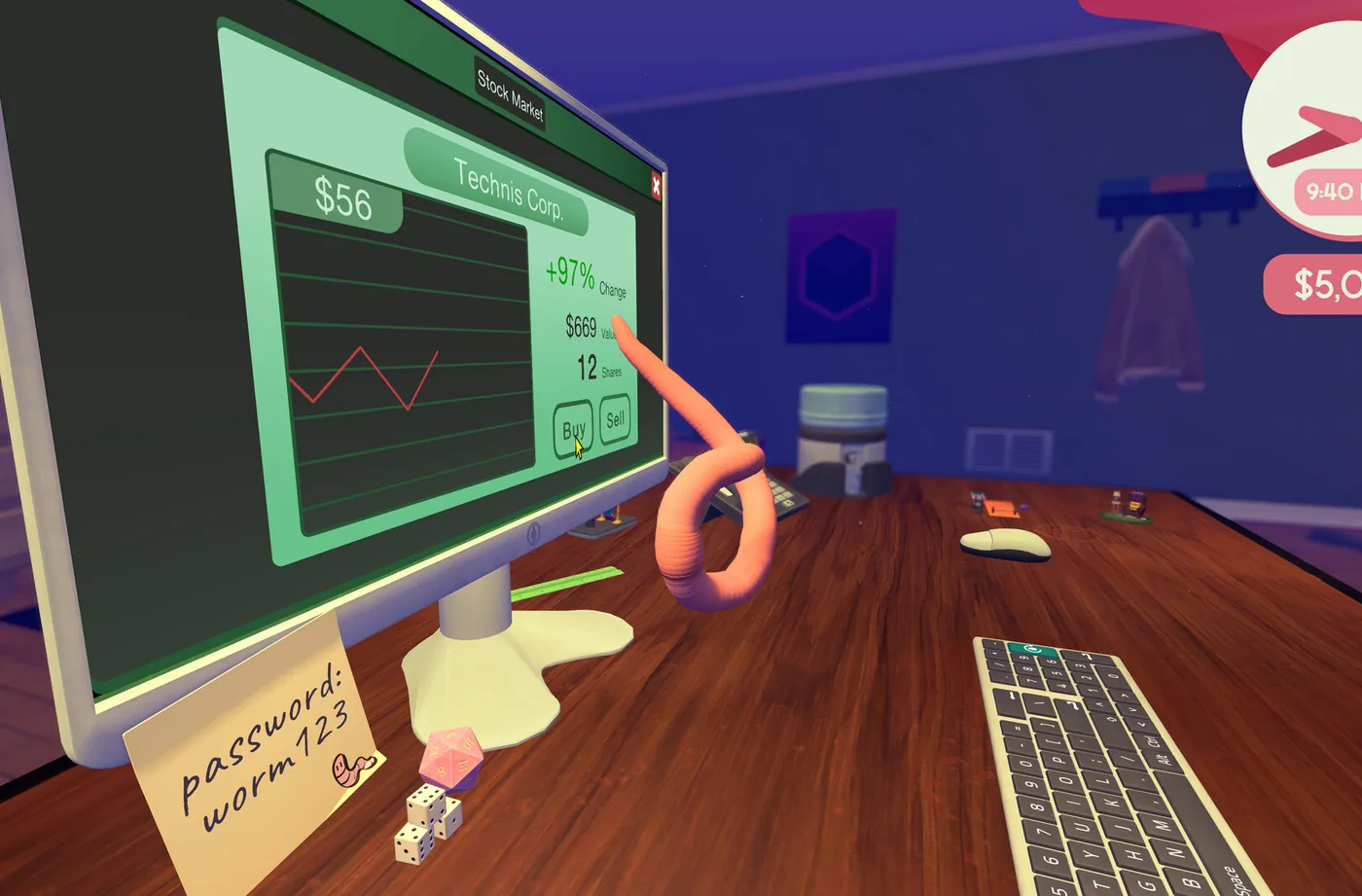
The trading screen is a window on the work computer titled Stock Market, and the only company name confirmed in any official material is Technis Corp. The press kit screenshot is our anchor for the numbers, and it shows a healthy session: a price of 56 dollars, a change of plus 97 percent, 12 shares held, and a position value of 669 dollars. Learn those four fields cold, because they are the entire vocabulary of the screen. Price is one share. Change is the move. Shares are yours. Value is what they are currently worth.
Below the numbers sit two buttons, Buy and Sell, and that is the whole order interface: no order types, no amounts menu beyond the Shift trick covered below, and nothing that resembles a short. The line chart tracks the selected stock's history, and the cash HUD keeps your bank balance pinned on screen, the same balance the shop spends from. One honest footnote for the detail-oriented: 12 shares at 56 dollars is 672, and the app shows 669. Three dollars are unaccounted for, no source explains them, and the working guess is fees or rounding. Trust the shares count, not the multiplication.
That is genuinely all the interface there is, which is the point. The game is not simulating a brokerage; it is simulating the one screen a junior analyst is allowed to look at between spreadsheets. The full element-by-element reference, including what players most often misread, lives in the stock market guide. This article is about what to do with the screen; that one is about the screen itself.
05Buying with Shift held
Buying shares one keybash at a time is the game's funniest self-own, and the Financial Insight perk tree quietly fixes it. One upgrade makes holding Shift place a buy, and in practice that unlocks bulk buying: press once for one share, hold to stack a real position before the chart moves against you. Given that tips expire the moment the market prices them in, speed is not convenience here. It is the difference between buying the news and chasing it.
The perk sits in the Financial Insight tree, which you level at the reading nook through a snake-style minigame, one point per level. The same tree carries the rest of the criminal toolkit: news events drawn onto the charts, a 5 percent interest perk, a coffee upgrade that makes the market tick faster, and advanced spreadsheets that pay better, which is a polite way of saying the tree also funds the trading. Reading trains best after 9 p.m., so the nightly wind-down and the market setup turn out to be the same errand.
Bulk buying also happens to be the door to one of the game's commoner achievements. Day Trader, buy or sell 100 shares in a day, sits at exactly a quarter of all players, and it is nearly free once Shift-buying is unlocked: a tip lands, you stack a position, you take profit, and the counter quietly fills. Without the perk it is an afternoon of individual key presses, which is a different kind of endurance sport.
06The tip-to-trade workflow
Compressed into a repeatable routine, trading a tip is six steps, and the order matters more than any single step, because every advantage here decays from the moment the information exists. A voicemail played at noon is worth a fraction of the same voicemail played at 8 a.m., and a position opened after the chart has moved is not a trade, it is a donation. Run the sequence every morning the phone has anything to say, and by late week it takes less time than the d20 roll.
- Play the morning voicemail before opening anything else.
- Check the wall calendar for dated events, orange as well as blue.
- Decide direction from the source: bullish buys, bearish stays out.
- Open the Stock Market app and confirm the chart has not moved yet.
- Hold Shift and size the position in one motion (Financial Insight perk).
- Sell into strength, or hold overnight and let the news finish landing.

07Your own orders move the price
The market in this game is small, and you are a participant rather than a spectator, which produces the least documented and most important mechanic in the system: your own orders move prices. One player documented the extreme case in the community thread on market behavior, pushing a stock past 100 dollars a share purely by buying it. No news, no tip, no earnings. Just a worm with a bank balance and a Shift key, bidding the price up against itself.
The practical consequences are worth internalizing early. A large buy fills while the price climbs, so the later shares cost more than the first ones. A large sell does the same in reverse, which bites hardest exactly when you are taking profit on a good tip. Community play suggests chunking big orders, buying in a few presses rather than one maximal hold, and expecting the chart to sag slightly when you exit. Nobody has pinned down the exact impact rules, and no verified source documents order-size limits, so treat your own footprint as one more thing to watch on the line chart.
08Who owns the profits (not you)
Read the contract you sign after buying the L-shaped desk, or at least the part launch players screenshotted, because the fine print is the best joke in the economy: Morton Corporation owns all trading profits. You, a worm, are generating returns on non-public information, and every dollar of them legally belongs to the company that paid for the phone the tips came in on. The game never enforces this beyond the paperwork. It does not need to. The joke is the enforcement.
The same corporate indifference runs through the rest of the storyline. The midnight investigation call, covered in its own guide, is three questions, an optional opportunity to blame Trevor, and a paid errand to destroy an expense report; no penalty for the trading itself has ever been documented in any review, thread or achievement. And the promotion at the end of the week, the entire reward for a week of criminal returns, arrives with famously no raise. Morton collects the upside and pays you in titles. Trade anyway. The money in your HUD still spends.
09One stock, then three, then whatever full access means
Pace your expectations around how the market unlocks. You start with one tradeable stock and one calendar task pointing you at it. After the L-shaped desk, at 1,000 dollars, and the contract you sign, print, scan and return, Steve calls with the upgrade: you'll be able to trade three different stocks instead of just one. Tippy marks the occasion in character, celebrating three whole stocks, that's like the entire market. A later call grants full access to the stock portfolio, whatever that contains.
Two honest caveats belong next to that sentence. First, the three-stock call is your real starting line: one stock is a tutorial, three is an actual market with choices, and the tips get sharper the moment you can act on their direction instead of just their existence. Second, no verified source itemizes what full access adds. The post-call stock list is undocumented, and the wiki farms have already invented names for it. When the call comes, look at your own screen and trust it over any fan site.
From here the site splits by mood. The stock market guide is the element-by-element reference for the app itself. The dip-buying guide covers the days the tip was wrong, the day trader guide covers the 100-share sprint, and the consequences guide explains the midnight call in full. The phone guide, meanwhile, covers the machine every one of these strategies starts with.