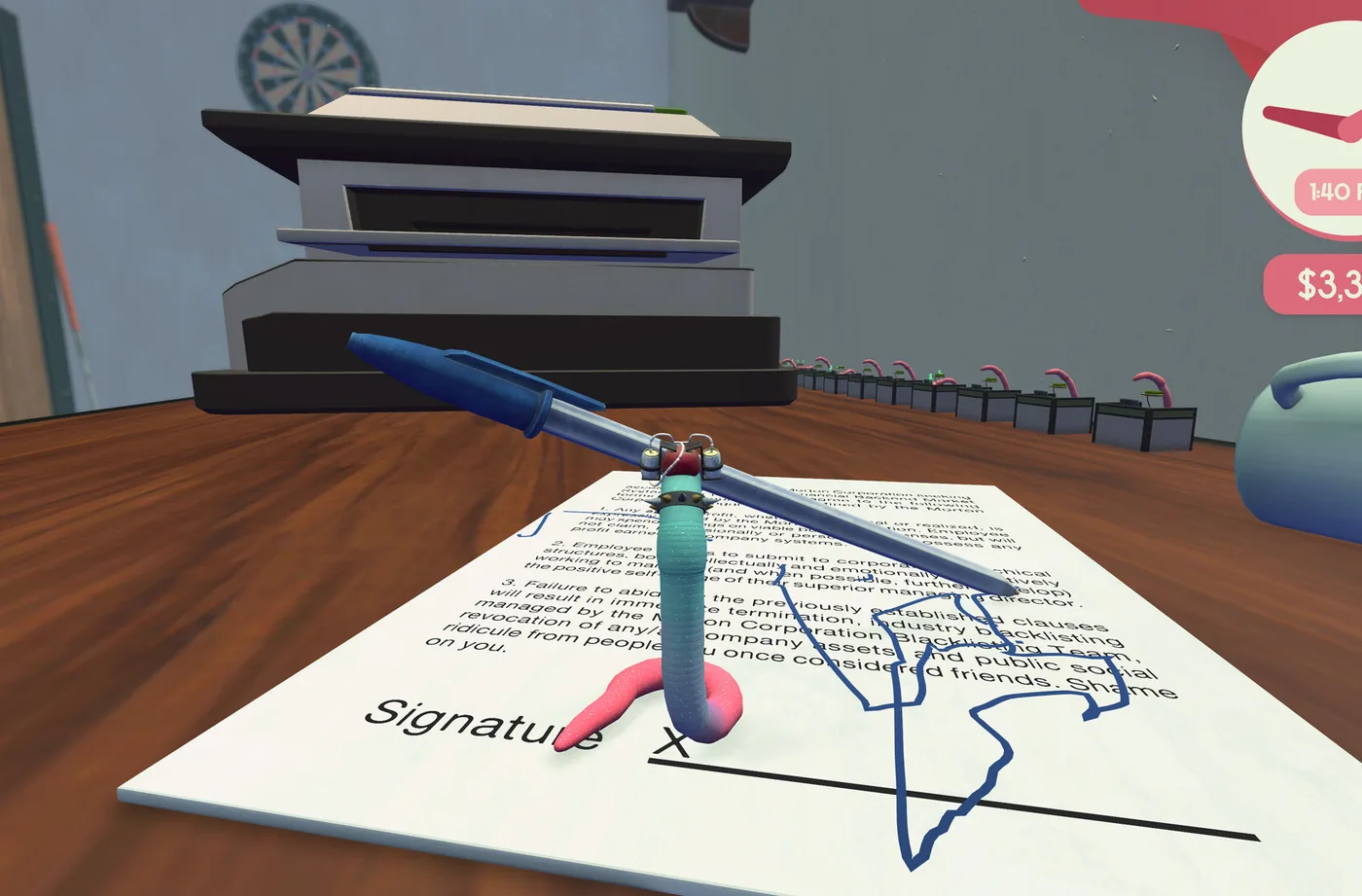
Independent fan guide. Details reflect the launch patch (v1.0.3) and cite official sources; if the game updates, in-game text always wins.
01The shape of an efficient day
A day in Worming from Home is a scheduling problem wearing a physics engine. The game hands you a gym, a reading nook, a stock market, a phone that never stops, and about sixteen working hours — then lets you discover what most players discover around day three: the day has natural slots, and fighting them costs real money. Train at the wrong hour and the session pays out slower. Read at the wrong hour and the nook underperforms. Sleep badly and tomorrow arrives pre-taxed.
None of this is hidden, exactly. The timing bonuses come from the perk trees: a Muscle Mass perk makes gym training faster before 10 a.m., and a matching Financial Insight perk makes reading train best after 9 p.m. Tippy announces mechanics like these in his lower-right hints, which are easy to miss and do not repeat, so plenty of players grind the gym at midnight all week and wonder why progress crawls. The perks are the game telling you its own schedule.
This guide assembles the schedule. It covers the morning routine in the order that saves deadline bonuses, the sleep math behind next-day debuffs, the batching that turns five spreadsheets into extra pay, the windows that matter for messages, and how trading fits around a full workday without taking it over. The table below is the whole philosophy in one grid; the rest of the article is the reasoning.
| Time of day | Best activity | Why |
|---|---|---|
| Before 10 a.m. | Gym session | The morning training perk pays out fastest |
| Early morning | Calendar, voicemail, d20, then tasks | Deadlines expire; tips arrive overnight |
| Midday | Spreadsheet block | Five files inside 24 hours stack a $200 bonus |
| As they arrive | Messages | M's replies pay out within one real-time minute |
| Workday gaps | Check the market | The app lives on the PC you are already at |
| After 9 p.m. | Reading nook | The evening reading perk trains fastest |
| Before ~3 a.m. | Sleep, in the pot | Short sleep applies a next-day debuff |
02Sleep is a stat
Sleep is the least glamorous system in the game and the one most worth managing. Sleep duration converts into next-day buffs and debuffs, and the numbers are real: about five hours of sleep lands you a 4 percent penalty to movement and training efficiency the following day. Four percent sounds small until you spend it. A slower worm misses keys, a weaker worm takes longer at the gym, and the whole schedule slips by exactly the margin the debuff predicted.
Skip sleep entirely and the game makes the decision for you: somewhere around 3 a.m. you pass out wherever you are. Besides the indignity, there is a practical sting — a camera lock bug tied to the 3 a.m. passout sits on the launch-week bug list, and groggy worms make poor witnesses. The clean pattern is to end the day deliberately: finish the evening reading session, crawl into the plant pot, and wake up with the debuff column empty.
A late Muscle Mass perk removes sleep debuffs entirely, and it changes the calculus at the end of the week. Until you have it, treat bedtime as an appointment. After you have it, late nights cost less — which matters in the run-up to the finale, when roughly eight thousand dollars of community-reported shopping sits between you and the interview and every evening counts.
03The morning order: calendar, voicemail, d20, tasks
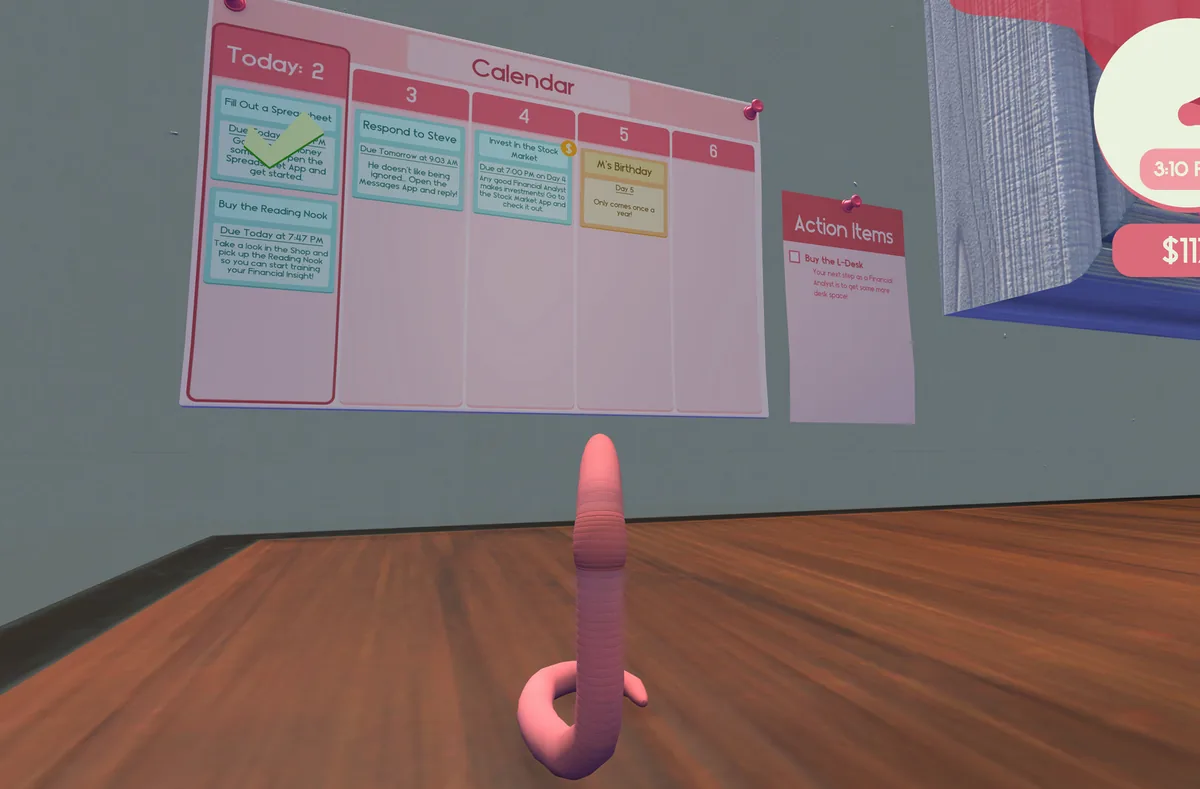
Run the morning in a fixed order — calendar, voicemail, d20, tasks — and the reasoning is about expiry dates. The wall calendar color-codes the day: blue entries are deadline tasks with actual due times, orange entries are events. A blue entry like 'Invest in the Stock Market — due 7:00 PM Day 4' is a scheduled payment for attention you were going to spend anyway, and missing the window forfeits the bonus. Calendar first means the day starts with its obligations visible instead of remembered.
Voicemail second, because the phone is where the week's real information arrives: Steve's stock tips, calendar events, and the occasional scam with a reward attached. The tips matter beyond their face value — they move the market you trade, so hearing them early shapes what you do with the midday gaps. A tip you discover at 8 p.m. is a trade you missed at noon.
The d20 third, because it is free and once per day. A natural 20 is the Stroke of Luck achievement, which 26.9 percent of players hold, and the game rewards a natural 1 in its own quiet way. Then, and only then, the task queue. At that point you know every deadline, every tip and every roll, and the actual work happens with the whole day's context loaded. The routine takes about a minute once it is habit.
04Batch your spreadsheets
Spreadsheets pay per task, and the game quietly pays a second time for volume: five completed files inside 24 hours earns a 200 dollar bonus. That bonus resets the incentive structure. Five scattered files across a distracted day pay once; the same five files in one focused block pay twice, and the block version takes less wall-clock time because you stay in typing rhythm.
The block wants a slot where your patience is freshest — for most players that is mid-morning, after the routine and before the messages pile up. Later files ask for Ctrl formatting: bold, italic, copy, paste. A worm cannot hold Ctrl, so the community method is to park a die on the Ctrl key and bump B or I or C or V, remembering that arrow keys still work with Ctrl held while typing does not. Set the die up before the block starts, not during it.
Pay scales with your Financial Insight level, and the advanced spreadsheets perk adds harder, better-paying files, so the batch grows more lucrative as the week goes on — provided your typing keeps pace. The keyboard guide covers the gear side; the short version is that the chunky starter board outtypes its expensive descendants for accuracy, and accuracy is the batch's real currency. One botched cell means the file again, and the 24-hour window does not care whose fault it was.
05Messaging windows
Messages are the only system in the game with a real-time clock attached. Respond to a message from M within one real-time minute and you earn Wow, You're Desperate, which 47.8 percent of players hold — nearly half the player base has, at least once, dropped everything for a notification. The achievement is the game's joke about workplace communication, and it doubles as the tutorial: notifications deserve attention while they are live.
The other contacts reward discipline rather than speed. Steve wants one-word answers and gives stock tips when flattered. Trevor is easily offended by vague replies, and his goodwill is a longer-term asset than any single conversation. Every reply must be typed exactly, letter for letter, or it does not send, so the real skill is choosing the option quickly and typing it slowly — the opposite of most players' instincts.
Fit messaging into the day's gaps rather than around them. A workday has natural dead air: while a print job finishes, while the market meanders, while your worm catches its breath. The one-minute M window is the exception that proves the schedule — most conversations wait, and the ones that do not wait announce themselves with an achievement.
06Trading around a full workday
The stock app lives on the work computer, which is the most convenient fact in the game: you are already there. Trading around a job is not about watching charts; it is about pre-positioning. Tips arrive as Steve's voicemails and as orange calendar events, and both arrive before the moves they predict. A worm who buys before the event and works through the afternoon has traded all day without stopping work.
Overnight is where the quiet money lives. A launch stream held shares through two nights and posted +17 and +21 percent net-worth days back to back — community-reported, from one playthrough, but consistent with how the game's news-driven moves behave. The Financial Insight tree supports the lifestyle: a perk reveals news events on the charts, the 5 percent interest perk compounds idle cash, and a coffee perk makes the market tick faster while you are actually watching it.
Two cautions from the community's first week. Your own orders move prices — one player pushed a stock past 100 dollars a share through sheer buying — so size matters in a market this small. And losses are real; no debt mechanic has been observed, but a bad position ties up cash the spreadsheet block was supposed to be compounding. The promotion asks you to make some money and develop that portfolio, which steady gains satisfy without heroics.
07The perk point economy
Both perk trees pay one point per level and lay their perks out radially, which makes progression a genuinely spatial decision: you can see the whole tree and the routes through it. Points come from the two minigames — the gym's Breakout-style session for Muscle Mass, the nook's Snake-style game for Financial Insight — and both minigames reward the same thing the schedule rewards: showing up in the right slot.
The trees have gear gates. Muscle Mass tiers unlock through Worm Weights, then the Worm Barbell, then the Squat Machine at roughly 1,800 dollars by community reports. Financial Insight gates through the Reading Nook itself, which costs about 10 dollars and upgrades from Comfy to Cozy, raising your reading cap. Budget the gear into the week early, because a capped worm earns points slower no matter how good the routine is.
The completion achievements sit at 35.3 percent for Absolutely Massive and 34.6 percent for Book Worm, which tells you full trees are an ordinary goal rather than a grind wall. Along the way the trees hand out schedule-relevant perks — sleep-debuff immunity, the morning gym window, bulk buying with Shift held, and Dress to Impress, which pays 10 percent extra income for wearing a hat to work. The hat is a financial instrument. Plan accordingly.
08The progress report is your dashboard
Every day closes with a progress report summarizing your earnings and net worth, and most players click past it. Treat it as the dashboard it obviously is. Two numbers, read in ten seconds, tell you whether yesterday's routine actually worked: earnings show the day's activity, net worth shows the week's direction. If earnings are fine and net worth is flat, the money is being spent rather than invested. If both sag, the schedule slipped, and the report will show where.
The report is also the game's honesty check on optimization itself. The point of a tighter routine is a steeper net worth line, and the line either steepened or it did not — no vibe-based performance reviews here. Players chasing the promotion chain can read the finale's shopping list directly off this graph: grow net worth toward that roughly 8,000-dollar total with the contract done, and the phone rings when Steve is ready.
One habit worth building: check the report before planning sleep, not after waking. The worm that ends the day knowing tomorrow's first deadline sleeps better than the worm that finds out at the keyboard, and the debuff math from earlier applies. The dashboard closes the loop the schedule opened.
09What optimization actually buys
Be clear about what a tuned routine buys, because it is not the story. The story passes at any pace. Optimization buys compounding: money becomes upgrades, upgrades make every action faster and cheaper, and the surplus buys more money. Interns are the clearest example — 400 dollars each, passive income you can buff permanently with coffee or water, per a developer confirmation — and the gear lines are the same deal at larger denominations.
By the end of the week the compounding lands on the promotion chain. The webcam and the soundboard cost about 8,000 dollars between them by community reports, the L-shaped desk 1,000 before that, and that shopping is what turns the portfolio requirement into a checkbox. A worm with a tuned week buys the finale without noticing. A worm without one spends two extra days grinding spreadsheets, which builds character and nothing else.
And the counterpoint, sincerely: none of this optimization is required. The story runs three to five hours at a relaxed pace, the accessibility tags include playable-without-timed-input, and the game's actual content is the nonsense between tasks. Optimize because the systems are fun to tune, not because the worm gets fired otherwise — no verified source has ever documented a worm being fired. The calendar can wait five minutes while you commune with the pile of dirt.